I bet you thought I was going to discuss Tibetan protests for independence, or Chinese/U.S. relations? Hell no. This is something much more important. This post is about Axl Rose and the latest incarnation of Guns ‘n Roses. This is about Chinese Democracy.
Chinese Democracy is a legendary G’nR album. Those in the industry can just say “Chinese Democracy”, and that is shorthand for so many, many things. None of them good (especially for Geffen Records). Chinese Democracy has not been released yet; even though Axl and various versions of G’nR have been working on it since 1994. That is, work on Chinese Democracy started during Bill Clinton’s first term. According to the New York Times, Rose has blown $13 million recording Chinese Democracy (as of 2005). Seventeen different “musicians” have worked with Axl on tracks for the record, including Sebastian Bach and Shaquille O’Neil. ABOVE: Axl Rose (center) hard at work on Chinese Democracy
Fun Chinese Democracy fact: A child born the year that work commenced on Chinese Democracy would now be starting High School.
What’s the hold-up? That story is as confusing as, well, the possible development of democracy in China. First and foremost, Axl Rose is insane. That much is clear. But Axl has blamed, alternatively, bandmembers come and gone, Geffen Records, and several fired managers for the delays. Axl has been on a Chinese Democracy tour, off and on, since 2001. He has been perpetually working these tunes out on the road. (Well, when he chooses to appear for his scheduled shows, which is about 50% of the time). The funny thing is that by many accounts, the tunes are great and sound of vintage G'nR.
Fun Chinese Democracy fact: Axl has worked longer on Chinese Democracy than it took the Beatles to form, tour the world several times over, film four movies, record and release 13 albums, and break up.
BELOW: Will Axl accept Dr. Pepper's challenge to finish Chinese Democracy this year?
VERSUS
Rose has consistently provided release dates since about 2005; all of which have come and gone. But this last week the ultimate challenge was put to Axl. Dr. Pepper has offered a free can of Dr. Pepper to every American-with the exceptions of former G’nR guitarists Slash and Buckethead (not to be confused with current G’nR guitarist Bumblefoot)-if G’nR releases Chinese Democracy in the 2008 calendar year. Axl responded in an open letter to Dr. Pepper, thanking them for their support, and he even offered to share his Dr. Pepper with Buckethead since “some of Buckethead’s performances are on [Chinese Democracy]”.
Demos of varying quality and authenticity have been leaked to radio and the internet over the years (followed by lawsuits). Some of these tracks indeed sound promising. Former Skid Row singer and reality TV star Sebastian Bach, who has contributed backing vocals to some Chinese Democracy tracks, describes the record, in its current state, as “a very cool album – it’s badass with killer screams, killer guitar riffs…the word is ‘grand’. It’s fucking epic.” Well, there you go.
All we can do is wait, hope and pray that Axl and G'n R deliver Chinese Democracy within this calendar year so we may finally savor this “fucking epic” along with our free can of Dr. P.
As slightly previewed in my back and forth with Johannes in the previous post's comments section, I view THE LAST WALTZ as the greatest rock and roll documentary ever made. (True, the competition is sparse, because there just aren't that many great rock docs out there.)
The Band. One of the greatest groups of their (or any) era; The Band released two unquestionable masterpiece records, Music From Big Pink and The Band, then tried in vain to recapture that magic for the rest of the 1970's, and finally folded for all intents and purposes in 1976. (They did release some things afterwards, and regrouped without Robbie Robertson in the 1980's and 90's...but as far as The Band when they really mattered, they folded their tent in '76). This most Americana of bands was comprised of four Canadians and one Arkansan. They cut their teeth playing jukes and dives across Canada and the U.S., until Bob Dylan finally plucked them from obscurity to be his backing band on his seismic first electric tour in the mid-60's (the one that changed the course of rock history). They were worshiped like few other bands by their fellow musicians. Eric Clapton to this day insists that merely listening to The Band’s debut was one of the main inspirations for folding Cream. Clapton even traveled to their communal home/studio in Woodstock (the 'Big Pink' referenced in the title of their debut) and asked them if he could join as their guitarist. Not too keen on the competition, Robertson told him "no thanks."
Key to The Band’s greatness was the integrated approached they took. Each member was a multi-instrumentalist, and they also boasted three expressive and unique singers. Robbie Robertson wrote most of their original material. Charges of dictatorial tendencies aside, Robbie insists that he begged the troubled Richard Manuel to share the songwriting burden (Manuel equally shared the songwriting on the debut); but Manuel was creatively spent after that first record and was satisfied to sit back and play keyboards, occasionally drum, and be their primary vocalist. Levon Helm (drums) and Rick Danko (bass) were the loosest white rhythm section in all of rock (listen to "Don't Do It" from Rock of Ages if you want to argue that point with me), Manuel’s singing could truly break your heart, Garth Hudson was a wizard at filling the musical space with an array of instruments, and Robertson was a restrained but wonderful guitarist who also wrote some truly classic tunes.
Robertson finally decided to call it quits in ‘76. The rest of The Band did not agree, but Robbie was the one calling the shots at that point as relations in this once communal group were stretched to the breaking point. He decided they should go out with a bang. Throw a farewell concert to end all farewell concerts, invite lots of fellow musicians of the day to share the stage and film it all. Enter Martin Scorsese. Bill Graham let them use the Winterlands in San Francisco on Thanksgiving of that year for the festivities, and Graham even provided a full Thanksgiving dinner for the fans before the show.
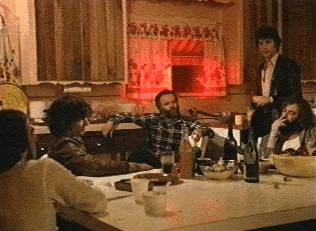
ABOVE: The Band remembers the old days (Martin Scorsese at far left, Levon Helm not pictured)
THE LAST WALTZ is much more than a mere performance video. Scorsese wanted to capture the group in interviews, hanging out, and in the studio as well as on stage. What he got was alternatively whimsical, insightful and deeply sad. This is nothing more than a testament to the toll of the road. One scene that sticks out is an incoherent Manuel barely able to get through telling a simple story from their early days, even with bandmates carefully prodding him along and clear multiple takes and edits by Scorsese. What should have been an amusing anecdote of hard times when they were starting out becomes a scene showing a man on the edge. Manuel would eventually hang himself several years later in a hotel bathroom.
But you’ve also got a playful Danko giving you a tour of their studio and reveling in the fact that it used to be a brothel before they bought it and converted it. Also a clear-eyed Robertson admitting that he is exhausted after 16 years on the road, with an obviously frustrated Helm sitting quietly next to him, clearly wanting 16 more years of the same and pissed off that Robertson is calling it quits for the rest of them. Helm and Robertson still have not reconciled, and Helm's opinion of THE LAST WALTZ is about as low as his opinion of Robertson. (Helm famously refused to show up to The Band's induction into the Rock and Roll Hall of Fame because he did not want to share the stage with Robertson, and even more telling, he waited outside of Rick Danko's funeral until Robertson left, only then did he go in to pay his own respects to his fallen bandmate. Helm views THE LAST WALTZ as a Scorsese/Robertson ego trip, reducing the rest of The Band to mere sidemen in their film project. Helm often points out with glee that in all of the shots where Robertson appears to be singing passionate back-up vocals, his mike was turned off the entire show).
BELOW: Robertson trying to sound deep in an interview with Scorsese, although I am impressed that he was able to catch the fly with with bare hand. The unintentionally funny Robertson interview clip is followed by an incendiary performance of "Up on Cripple Creek"...man that Levon Helm could sing
In the end what makes THE LAST WALTZ so special are the performances. The Band themselves go through their own greatest hits with vigor and passion. Highlights include a visceral “Stagefright”, a moving “The Night They Drove Old Dixie Down” (with killer horns arranged by Allan Toussaint), a funky “Up On Cripple Creek”, and a drop dead gorgeous “It Makes No Difference” (could Rick Danko’s performance here be the most emotionally raw vocal in rock? It would be in the running. And what about Robertson's spot-on guitar solo?) Then you’ve got The Band backing a who’s who of 70’s greats: Neil Young and Joni Mitchell together on “Helpless”; Muddy Waters on a smoldering “Mannish Boy”; Clapton trading licks with Robbie on “Further On Up the Road”; The Staples turning “The Weight” into a soul barnburner; Joni Mitchell’s “Coyote”; a trip to the Big Easy with Dr. John on “Such a Night”; a celebratory “Caravan” with Van Morrison; “Mystery Train” with Paul Butterfield; a gritty “Who Do You Love?” with Ronnie Hawkins (the Canadian rockabilly legend that The Band supported when they were starting out, billed as The Hawks); even a groovy “Dry Your Eyes” with Neil Diamond…and finally a mini-set of loose rockers with Bob Dylan himself.
Funny story: Neil Young had just snorted a huge amount of cocaine backstage (being the '70's, Bill Graham had set up an entire cocaine room backstage for all the honored guests), and in the original film a hunk of white powder was clearly visible hanging out of Neil's nose as he performed "Helpless". With the magic of digital technology, Robbie and Scorsese have gone in and removed the offending powder from Neil’s nose.
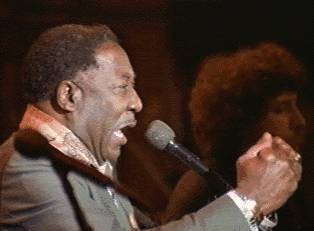
ABOVE: Muddy Waters shows the youngins how it's done
Some other accidents that are still there make for wonderful moments in the film. Muddy Waters' smoldering performance of "Mannish Boy" is very effective because most of the song is filmed with one camera focused on Muddy, slowly zooming in and out on the legendary bluesman. This was not due to artistic greatness on the part of Scorsese, it was due to rebellion by one of his cameramen. Scorsese made a mistake and called for a break in filming (to let the cameras cool down) during the song; not realizing that it was Muddy due up next. But this particular cameraman, so sick of Scorsese's constant orders being barked over his headset, had tossed off his headset earlier in the evening and decided to film guerilla-style. Hence his was the only camera rolling during the great performance. Another fantastic, unplanned moment was during Clapton's "Further On Up the Road", when his guitar strap popped loose right in the middle of his solo. Robertson, without missing a beat, jumped in and picked up the solo right there until Clapton was able to reattach the strap and continue on. Talk about watching each other's back.
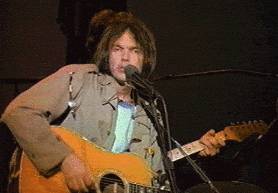
ABOVE: Does Neil Young know where he is?
The film and soundtrack capture an era. It is melancholy, celebratory, powerful and weary as hell. The performances are all superb. There was a time when I had this movie on an old, dusty videotape (thanks DRE), and I watched it every night for months at a time as I was going to sleep. I got to know every moment intimately (at least the first half), but in a dream state, half awake and half asleep. I can’t really explain it, but that is a great way to know THE LAST WALTZ. It is triumphant and tragic. The performances reveal the peaks which this group of musicians could still climb on a nightly basis; yet it also shows the toll this life takes on men. Some grow cold and decide to leave it behind (Robertson), some get so addicted to it that they cannot bear the thought of doing anything else (Helm), and some never make it out and become another rock and roll casualty (Manuel, and later Danko).
What to buy…
A couple years back, Scorsese and Robertson put together a beautiful DVD Special Edition of the film, with insightful extras. Likewise, the soundtrack was remastered recently with revelatory results. It was originally released on three records (two CDs), so the two disc version is still available. But I would highly recommend splurging for the 4-disc box set, which features many bonus cuts and covers the entire show performed that night. The bonus cuts are as good as what ended up making the original album and film.
As for other essential Band purchases: the debut Music From Big Pink and follow-up The Band are two of the more important albums released in the late 60’s. Greatest Hits is a good single disc overview. The Band: A Musical History is one of the better box sets ever released. It has the obvious cuts, but is packed with A-List rarities as well.
Some of you who checked GNABB late last night or this morning may have noticed a GNABB Obituary, wherein I dramatically declared the death of GNABB and thanked everyone who read or participated. This was posted due to a common problem we all face. Swamped at work and learning a new job, household duties, etc. I felt I needed to give up some things to tend to these other duties more fully, so I killed GNABB. Then my wife finds out what I did this morning and is furious and makes me resurrect GNABB. She promised me that she would take care of all household duties, I could quit my job...all so I can deliver the best GNABB possible. OK, not quite. But she did insist that I bring it back. So here we are, back in business. I hope that dispells any confusion, and I hope that I did not send my thousands of readers into deep despair with my message last night.
Coming soon...a fascinating discussion as to why "The Last Waltz" is the greatest rock doc ever made...
Colin Hay (of Men At Work fame) is one of my musical heroes. Check out this great acoustic version of "Down Under". His shows are typically like this clip: solo acoustic with lengthy and amusing anecdotes between songs. I saw him live in Austin in a small club a couple of years back. There were perhaps 12 people in the audience. But he still gave a great show and hung out afterwards and was very friendly. To this day he possesses my favorite voice in rock. I'm glad he's getting some attention (finally) for his solo work. Enjoy...
I had an experience last night that got me thinking about our recent discussions here at GNABB and around the nation about race issues.
We have some black neighbors who live across the street, and last night they were having an old fashioned crawfish broil in their garage (I'm not making this up, they're from Louisiana). As I pulled in my driveway, my neighbor came across the street and invited me over for some crawfish and socializing. My wife was out most of the night with some friends on a girl's night out, so I went over solo. I ended up staying over there for about 5 or 6 hours, sitting in their garage with mountains of crustacian carcasses in front of me as I consumed about 500 pounds of crawfish and talked about a number of topics with my hosts. Over the course of the long evening, I was struck by the diversity of folks who came through that garage. From my count: two black couples with two young children (one kid took a liking to me, so there I was, with four year old Tyson sitting on my lap; he didn't seem to mind that I was white), one mixed couple (black male, hispanic woman), two white couples with four kids between them, and eventually when my wife got home she joined us (I'm a white male and she is mixed, half Hispanic/half white). Little white and little black kids laughing and enjoying crawfish; while an assortment of white, black and Hispanic folks sat around drinking beer, eating crawfish, and joking, laughing and telling stories about every topic under the sun.
The point? Perhaps crawfish are the answer to healing racial wounds. But also, from our conversations here regarding my post about Rev. Wright and Obama, and from the things we have heard on the airwaves over the last week or so, we have MAJOR racial issues in this country. But to be honest with you, I cannot think of many other countries where you would see a scene like I was a part of last night. There was not the least bit of tension in that garage, it was all good times. Now, it is true that certain topics were not discussed. And it might be interesting to ask each person privately about their opinion on race relations in America...but still. When religious factions and different tribes elsewhere are killing each other in other parts of the world, is it really so bad here? When in many parts of Europe there is a real battle brewing between the native populations and the Muslim immigrants, are things here so horrid?
And that does not even adequately describe the racial diversity on my street. We have some Pakistanis living a couple of doors down, and some Koreans across and up two doors.
The closest thing to tension I have witnessed was when the Korean lady was stealing new grass from several other newly built homes in the neighborhood because her own grass had not yet been delivered, and my black neighbor yelled at her. Perhaps that is our version of tense black/Korean relations, like you hear about in South Central L.A. I don't know.
I realize that there is one common denominator here: economic class. It costs a certain amount of money to live in our neighborhood, and all of these people have that money and are professionals. Which is why I have often thought that there is more tension and divisiveness along the lines of economic class than race. At least in today's society it seems that way.
I've been doing polls here since the inception of GNABB, but have yet to conduct a conversation about the results. The latest poll just closed, and after thousands upon thousands of votes, here are the results:
Perhaps these results are in part reflective of the demographics of the GNABB Nation. I have found that one's favorite period of music usually coincides with their teenage/high school years where for most normal people things like music and other pop culture are of utmost importance. (For people like me, that period of obsessiveness continues to this day).
The 60's as winner doesn't surprise me. Rock and roll (and I am assuming most readers here are primarily rock and roll listeners, in whatever favorite genres) really came of age and blossomed in that decade. But what surprised me was the strong showing for the 1990's. I didn't think that was a particularly strong decade for tunes. For the record: my vote went with the 1980's (notice I worded the poll carefully, asking for "favorite", not some sort of objective "best" or "most significant"). Where's the love for Duran Duran and Men At Work, people?
ABOVE: 80's music was noted for its substance over style, and its hardhitting political and social impact on the key issues of the day...oh wait, I meant the 1960's
I'd be curious to hear from voters (or even non-voters) in this last poll as to what made your decade of choice so great...
"When a distinguished but elderly scientist states that something is possible, he is almost certainly right. When he states that something is impossible, he is very probably wrong."
Prolific sci-fi visionary author and staunch atheist Arthur C. Clarke passed away on Wednesday. He is justly respected for his many sci-fi novels as well as non-fiction work, but I am a big fan of his co-written screenplay with Stanley Kubrick for the groundbreaking film ‘2001: A Space Odyssey’. Clarke and Kubrick butted heads with each other over many key aspects of the project, and Clarke admitted to being somewhat baffled by Kubrick’s finished product; but Clarke's ideas were key to the film (which was born from his short story, "The Sentinel"). He came up with the concept of communications satellites in 1945, decades before their use (and he pioneered the idea of geostationary satellites). Greatly respected throughout his long career, Clarke has been cited by many scientists and top minds at NASA as a key inspiration. He is honored as a national hero in his adopted home of Sri Lanka. RIP ACC.