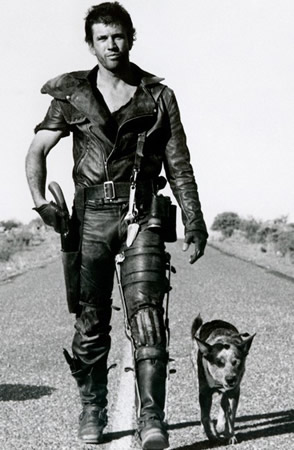
I've always had somewhat of a soft spot for Mel Gibson. With Mel, fans/former fans are confronted by one of the classic dilemmas of fandom. Can you separate a man's personal behavior (or perhaps political activity) from their work as an entertainer? Take Bruce Springsteen, a longtime favorite of mine. He has become quite politically outspoken in the last decade, and generally speaking he is on the opposite side from where I am. Yet, I can still admire his music, however much I may resent being preached to by a high school dropout who doesn't fully understand the ramifications of policies he promotes. "Born To Run" still rocks.
For obsessives like me, "entertainer" is not a strong enough word anyway. Music and to a slightly lesser degree films are a major part of my life, so I get quite invested in the work that these people create.
If you had asked me a decade ago, I would have said that I was a big fan of Mel's work, especially his early work. Gallipoli, Mad Max, The Road Warrior, The Year of Living Dangerously and The Bounty are all movies that I admire quite a bit. I even enjoyed the first Lethal Weapon, for what it was. I can accept, and even admire, Mel's strong religious beliefs. Standing out as he does in Hollywood, he's the rebel for sticking to such a strict, conservative line of faith (hardcore catholic stuff, like pre-Vatican II).
But Mel is insane. That has become clear with the distressing string of police reports and recordings of his ranting. You name it: anti-semetic, racist, violence towards women...Mel's been captured on tape for all of it (they are all on YouTube). Hell, his 80 year old stepmother filed a freaking restraining order against him recently! It has become big business to try and entrap Mel on tape these days. But, he did bring it all on himself. Hollywood douchebag Joe Esterhaus and Mel's ice queen Russian girlfriend both have gotten some publicity by releasing surrepticious recordings of Mel's ravings. (My personal favorite: on the recording sleazebag Joe Esterhaus released, after berating Esterhaus for delivering a crappy script for a project they were developing, he bellows "Who wants to eat!? Who wants some f*cking dinner!!" at an almost unfathomable volume and rage as he strolls the halls of his Costa Rica home calling to servants for a meal. Or perhaps screaming that it should be obvious to his girlfriend that oral pleasure be given before she retires to the hot tub in his house. It is ridiculous that he even needs to explain this, according to Mel. "Even if the house is burning to the ground," she should perform this duty first.) But, of course, he is also a very religious man.
Reading about these incidents and hearing them is sometimes shocking, sometimes funny just in their intensity and absurdity, but mostly very sad coming from someone who was seen before as quite talented and who gave charismatic performances.
So, how do you view his work in light of who he is? Tough question. I still love those early films. In a way, though, his recent explosions actually inform some of these early performances. Take a look at his character in Lethal Weapon. While the sequels were much lighter, the first film was quite dark in places. Mel's character, if you recall, was suicidal and performed his police duties with a death wish. At the time, I and most fans probably figured that those scenes where he goes nuts and rages were craft, were scenes of lustful Shatneresque over-acting. Or the mutinty scene in The Bounty, where he and Bligh (Anthony Hopkins) rage at eachother on deck, with Gibson finally just screaming incoherently up at the heavens (a somewhat accurate portrayal of the mutiny, though). The scream in The Bounty sounds quite similar to his screams on several of the recordings released by his girlfriend. I guess my point is, some of these early performances, in hindsight, were not merely acting (and some over-acting). He was reaching within himself, harnessing some of that rage within in those performances. Interesting in hindsight.
Hard to like the man anymore, but you can still admire and enjoy the work.
Friday, July 20, 2012
Wednesday, July 18, 2012
Song #14
Title: "Cortez the Killer" (live)
Artist: Neil Young & Crazy Horse
Album: Weld, 1991. Original studio version from Zuma, 1975. Also available on Live Rust, 1979.
Written By: Neil Young
Several versions to choose from, but I usually return to the Weld version. It is actually slower than the studio version, but features some of Neil's most passionate playing on record and is the most majestic version. "He came dancing across the water / With his galleons and guns..." God what great lyrics! The song is so gorgeous that I can even forgive the blatant historical inaccuracies. "Hate was just a legend and war was never known." No. The Aztecs were one of the most brutal tribes in the Americas, and one of the reasons Cortez was able to conquer them is because other tribes were so sick of being slaughtered by the Aztecs, so they joined with Cortez and the Spaniards to kick Montezuma's ass. Of course, they came to regret it once under even more brutal Spanish rule. But no matter, it is mostly about the feel. The two solos (one starting at 5:40 and then especially the one starting at 7:35) show why Neil Young is such a brilliant electric guitarist, technique be damned.
Tuesday, July 17, 2012
Song #16
Title: "Red Rain"
Artist: Peter Gabriel
Album: So, 1986
Written By: Peter Gabriel
This is the song that first got me into Gabriel's music. Stewart Copeland plays the hi-hat on the track. Not the drums. Just the hi-hat. And even with just the hi-hat, you can tell that it's him.
Artist: Peter Gabriel
Album: So, 1986
Written By: Peter Gabriel
This is the song that first got me into Gabriel's music. Stewart Copeland plays the hi-hat on the track. Not the drums. Just the hi-hat. And even with just the hi-hat, you can tell that it's him.
Saturday, July 14, 2012
The Battle For Historical Narrative
"I hope never to see Fletcher Christian again. Unless it is to see him hanged." - Attributed to Capt. William Bligh, 1789
What's not to love about the story of the mutiny on the Bounty? British Empire, exploration, betrayals, Pacific paradise, beautiful women, what was perhaps the greatest tale of survival in naval history, a new civilization created, courtroom drama. Hollywood has certainly taken notice, as it has been the subject of five films so far. I've been fascinated by the event since I was a child.
Very briefly, the facts:
The Bounty was sent out under the patronage of British renaissance man Joseph Banks under the command of Lt. William Bligh. The mission was to sail from England around the dangerous waters of Cape Horn, to reach Tahiti. Tahiti had only been visited by a handful of British ships up to this time. The plan was the get hundreds of breadfruit plants from Tahiti and transport them to the West Indies, as they were seen as a cheap food source for slave labor. After a rough passage and failure to make it around the stormy seas of the Horn, the Bounty eventually did make it to Tahiti, where they were greeted warmly (the King remembered Bligh from his previous voyage under Capt. Cook, who was viewed almost as a god by the Tahitians). The Bounty stayed there for about 6 months, where the crew and officers developed close relations with the Tahitians. Once they did depart, trouble brewed onboard. Accounts vary widely, but Bligh was either acting as a tyrant or was the victim of a naturally rebellious crew. A mutiny occurred, led by officer Fletcher Christian. Christian set Bligh and about 18 other loyalists adrift in a skiff in the South Pacific, to certain death. Bligh incredibly navigated, without a compass or other equipment, the small boat an astounding 3600 miles to civilization. Meanwhile The Bounty returned to Tahiti under the command of Christian, where some of the mutineers disembarked, while others, along with some Tahitian women and men who were essentially duped and taken hostage, continued to sail. They finally settled on an uncharted island, started a new civilization that was rife with violence and intrigue, but that survives to this day on Pitcairn's Island, still inhabited by the Bounty's descendants, and is the least populated British possession. (A child-rape sex scandal that was much publicized rocked Pitcairn this last decade.)
When Bligh finally returned to England, he was rightfully hailed as a hero. His 3600 mile epic journey in a little boat in the South Pacific was, and still is, acknowledged as one of the greatest feats of navigation and survival in naval history, complete with battling hostile natives and stormy seas en route. But an interesting thing happened. Soon after his return and after he was exonerated in his own court martial regarding the loss of the Bounty, Bligh set out on another voyage that took him away from England for several years. Meanwhile, the mutineers who had disembarked on Tahiti were captured by the Pandora, a ship the British Navy specifically sent out to hunt down the mutineers. (The voyage of The Pandora is a story unto itself, as it sank off of Australia, and incredibly the mutineer-prisoners that had been captured in Tahiti had to endure a shorter version of the open boat journey they had forced Bligh to take!) The court martial of the captured mutineers was a news sensation at the time, with three eventually being hung, four acquitted, and three sentenced to death but later pardoned by the King.
Two families made it their mission to take control of the narrative. Fletcher Christian's family and mutineer/pardoned prisoner Peter Heywood's family were both families of the upper crust, but had severe financial troubles. Yet they still maintained their friends in high places. While Bligh was away, they published accounts turning the narrative from a crew of villains taking the ship and setting 18 of their comrades adrift to what they thought was certain death to romantic heroes standing up to the abuse and tyranny of the evil Capt. Bligh.
Another interesting aspect of the story is that this is happening amidst bigger world events, such as the French Revolution and the beginnings of a new movement in British literature by the likes of Wordsworth and Byron (both of which entered the Bounty fray with writings of their own).
I've read quite a few books on the subject (including Bligh's own published log). Caroline Alexander's The Bounty may be the best, albeit very thorough. We simply do not know everything that happened. There are many accounts from many players, and they are fascinating in their differences. Not only that, but there are multiple accounts from the same person over many years that contradict their own earlier accounts. Money was thrown around liberally to get statements favorable to Heywood. You don't have just one adventure, but many. The mutiny. Pitcairn's Island and its eventual discovery by an American whaling ship. The trial. Bligh's epic open boat journey.
But the battle for the historical narrative is one of the aspects that intrigues me. What may be my favorite passage in Alexander's book sums up the bigger forces at work behind how the people then (and now) view The Bounty's story, how it was symbolic of the changing of eras:
Most serious studies of The Bounty fall somewhere either in between or side somewhat, and with serious caveats, on the side of Capt. Bligh. But Hollywood cannot resist the Romantic hero, and has portrayed Bligh as a blustering tyrant and Christian as the sensitive hero pushed too far. Just look at who has played Fletcher Christian in these films: Errol Flynn, Clark Gable, Marlon Brando, Mel Gibson (pre-psycho). In reality, Christian was a troubled soul, and by all accounts he was haunted by his setting Bligh adrift until his own murder on Pitcairn's Island by the hands of the Tahitian men who accompanied the mutineers (all accounts do agree on the exchange between Bligh and Christian on deck, where Christian, wild-eyed, shouts "I am in hell!" and Bligh tries to unsuccessfully appeal to their former friendship, "Fletcher, you have bounced my children upon your knee!") Funny enough, the last straw seems to be an incident where Bligh flew into a rage accusing Christian of stealing from his private stash of coconuts. Christian admitted to taking only one, when he was on the overnight watch and wanted to quench his thirst. At any rate, no doubt many of the mutineers were drawn back to their lost paradise of Tahiti, where several of them had developed serious relationships with the island women. The crew was uncommonly interesting, even the seamen. Several of them were quite educated, and there is strong evidence that several of them influenced and "pushed" the fragile but well liked Christian into leading the mutiny.
Of all of the film versions, 1985's "The Bounty", starring Anthony Hopkins as Bligh and Gibson as Christian, attempts the most even-handed treatment of these two men.
When Bligh returned to England, he and patron Banks tried to counter the propaganda campaign started by the Christian and Heywood camps. They were only marginally successful. I guess what continues to give this story life is that it is unclear what really happened over those almost two years in the South Pacific. Bligh certainly had a volcanic temper, but so did many other British captains of the time. Abuse from superiors was expected in the 1700's British navy. What made this voyage so different? That is what so many people, like myself, still try and figure out. The battle for the historical narrative, both in book and in film, and in the accounts of the many survivors, rages on.
What's not to love about the story of the mutiny on the Bounty? British Empire, exploration, betrayals, Pacific paradise, beautiful women, what was perhaps the greatest tale of survival in naval history, a new civilization created, courtroom drama. Hollywood has certainly taken notice, as it has been the subject of five films so far. I've been fascinated by the event since I was a child.
Very briefly, the facts:
The Bounty was sent out under the patronage of British renaissance man Joseph Banks under the command of Lt. William Bligh. The mission was to sail from England around the dangerous waters of Cape Horn, to reach Tahiti. Tahiti had only been visited by a handful of British ships up to this time. The plan was the get hundreds of breadfruit plants from Tahiti and transport them to the West Indies, as they were seen as a cheap food source for slave labor. After a rough passage and failure to make it around the stormy seas of the Horn, the Bounty eventually did make it to Tahiti, where they were greeted warmly (the King remembered Bligh from his previous voyage under Capt. Cook, who was viewed almost as a god by the Tahitians). The Bounty stayed there for about 6 months, where the crew and officers developed close relations with the Tahitians. Once they did depart, trouble brewed onboard. Accounts vary widely, but Bligh was either acting as a tyrant or was the victim of a naturally rebellious crew. A mutiny occurred, led by officer Fletcher Christian. Christian set Bligh and about 18 other loyalists adrift in a skiff in the South Pacific, to certain death. Bligh incredibly navigated, without a compass or other equipment, the small boat an astounding 3600 miles to civilization. Meanwhile The Bounty returned to Tahiti under the command of Christian, where some of the mutineers disembarked, while others, along with some Tahitian women and men who were essentially duped and taken hostage, continued to sail. They finally settled on an uncharted island, started a new civilization that was rife with violence and intrigue, but that survives to this day on Pitcairn's Island, still inhabited by the Bounty's descendants, and is the least populated British possession. (A child-rape sex scandal that was much publicized rocked Pitcairn this last decade.)
When Bligh finally returned to England, he was rightfully hailed as a hero. His 3600 mile epic journey in a little boat in the South Pacific was, and still is, acknowledged as one of the greatest feats of navigation and survival in naval history, complete with battling hostile natives and stormy seas en route. But an interesting thing happened. Soon after his return and after he was exonerated in his own court martial regarding the loss of the Bounty, Bligh set out on another voyage that took him away from England for several years. Meanwhile, the mutineers who had disembarked on Tahiti were captured by the Pandora, a ship the British Navy specifically sent out to hunt down the mutineers. (The voyage of The Pandora is a story unto itself, as it sank off of Australia, and incredibly the mutineer-prisoners that had been captured in Tahiti had to endure a shorter version of the open boat journey they had forced Bligh to take!) The court martial of the captured mutineers was a news sensation at the time, with three eventually being hung, four acquitted, and three sentenced to death but later pardoned by the King.
Two families made it their mission to take control of the narrative. Fletcher Christian's family and mutineer/pardoned prisoner Peter Heywood's family were both families of the upper crust, but had severe financial troubles. Yet they still maintained their friends in high places. While Bligh was away, they published accounts turning the narrative from a crew of villains taking the ship and setting 18 of their comrades adrift to what they thought was certain death to romantic heroes standing up to the abuse and tyranny of the evil Capt. Bligh.
Another interesting aspect of the story is that this is happening amidst bigger world events, such as the French Revolution and the beginnings of a new movement in British literature by the likes of Wordsworth and Byron (both of which entered the Bounty fray with writings of their own).
I've read quite a few books on the subject (including Bligh's own published log). Caroline Alexander's The Bounty may be the best, albeit very thorough. We simply do not know everything that happened. There are many accounts from many players, and they are fascinating in their differences. Not only that, but there are multiple accounts from the same person over many years that contradict their own earlier accounts. Money was thrown around liberally to get statements favorable to Heywood. You don't have just one adventure, but many. The mutiny. Pitcairn's Island and its eventual discovery by an American whaling ship. The trial. Bligh's epic open boat journey.
But the battle for the historical narrative is one of the aspects that intrigues me. What may be my favorite passage in Alexander's book sums up the bigger forces at work behind how the people then (and now) view The Bounty's story, how it was symbolic of the changing of eras:
"It was Lieutenant Bligh's ill luck to have his own great adventure coincide exactly with the dawn of this new era, which saw a devotion to a code of duty and established authority as less honorable than the celebration of individual passions and liberty. Coleridge's Anciant Mariner was a crude forerunner of the full-blown Romantic hero to be glamorized by Byron; but Fletcher Christian was the forerunner of them all..."
Most serious studies of The Bounty fall somewhere either in between or side somewhat, and with serious caveats, on the side of Capt. Bligh. But Hollywood cannot resist the Romantic hero, and has portrayed Bligh as a blustering tyrant and Christian as the sensitive hero pushed too far. Just look at who has played Fletcher Christian in these films: Errol Flynn, Clark Gable, Marlon Brando, Mel Gibson (pre-psycho). In reality, Christian was a troubled soul, and by all accounts he was haunted by his setting Bligh adrift until his own murder on Pitcairn's Island by the hands of the Tahitian men who accompanied the mutineers (all accounts do agree on the exchange between Bligh and Christian on deck, where Christian, wild-eyed, shouts "I am in hell!" and Bligh tries to unsuccessfully appeal to their former friendship, "Fletcher, you have bounced my children upon your knee!") Funny enough, the last straw seems to be an incident where Bligh flew into a rage accusing Christian of stealing from his private stash of coconuts. Christian admitted to taking only one, when he was on the overnight watch and wanted to quench his thirst. At any rate, no doubt many of the mutineers were drawn back to their lost paradise of Tahiti, where several of them had developed serious relationships with the island women. The crew was uncommonly interesting, even the seamen. Several of them were quite educated, and there is strong evidence that several of them influenced and "pushed" the fragile but well liked Christian into leading the mutiny.
Of all of the film versions, 1985's "The Bounty", starring Anthony Hopkins as Bligh and Gibson as Christian, attempts the most even-handed treatment of these two men.
When Bligh returned to England, he and patron Banks tried to counter the propaganda campaign started by the Christian and Heywood camps. They were only marginally successful. I guess what continues to give this story life is that it is unclear what really happened over those almost two years in the South Pacific. Bligh certainly had a volcanic temper, but so did many other British captains of the time. Abuse from superiors was expected in the 1700's British navy. What made this voyage so different? That is what so many people, like myself, still try and figure out. The battle for the historical narrative, both in book and in film, and in the accounts of the many survivors, rages on.
Wednesday, July 11, 2012
Song #17
Title: "Gimme Shelter"
Artist: The Rolling Stones
Album: Let It Bleed, 1969
Written By: Mick Jagger and Keith Richards
The dark side of the Flower Power 60's was never better captured than on this harrowing track by the Rolling Stones. Vietnam, Manson, Altamont, drug casualties, generational divide, credibility gap, assassinations...none are mentioned by name, but they are all there in the ominous mood. And while Jagger is great, this song really belongs to Merry Clayton's emotional delivery.
BELOW: Here's a video some dude on YouTube put together with many images from the 60's:
Monday, July 9, 2012
Subscribe to:
Posts (Atom)