Monday, August 2, 2010

Dez Prez Rankings: The Imperial Presidency

#5 of 39:
Theodore Roosevelt (26th president)
1901-09
Republican
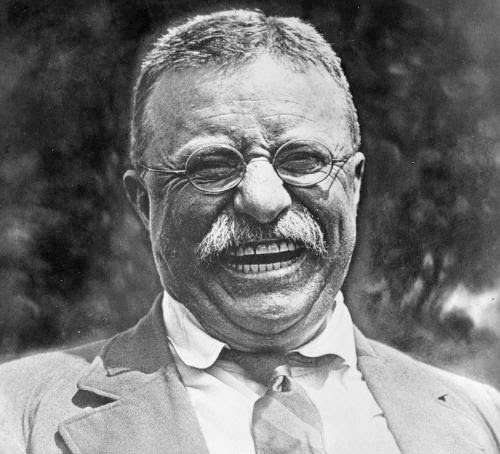


“Now look! That damned cowboy is president of the United States!”-Republican power broker Mark Hanna.

Teddy Roosevelt was a scary prospect to Republicans and Democrats alike. He was an impulsive, charismatic, independent, unpredictable, uncontrollable force of nature. The Republicans had been so alarmed at his popularity within their own ranks that they neutralized him by making him William McKinley’s vice-president (a political dead-end job where troublemakers could often be set aside where they would do little damage). Unfortunately for the powers-that-were, McKinley got shot. TR may have had the justly earned reputation as a cowboy ruffian who was always ready to step in the ring for a boxing match (one of his favorite pastimes), but he was also one of the most intelligent men with the most diverse interests to ever inhabit the White House, with the possible exception of Thomas Jefferson. He was the kind of man who would indeed slog it out with you in a boxing ring, but after showering off in the locker room, he could sit down with you and engage in a discussion of taxidermy, political theory or religion.

The fears of party leaders were well founded. Teddy served more as a dictator than a president, but always claiming to be ruling through the will of the people. He once said, “I think it [the presidency] should be a very powerful office, and think the President should be a very strong man who uses without hesitation every power that the position yields; but…he should be sharply watched by the people and held to a strict accountability by them.” Well, he actually practiced the first part of that statement. Not so much the second part. He used what he called the president’s “bully pulpit” to rage against power unchecked, be they powerful monopolistic corporations, uppity unions or uncooperative foreign allies and enemies. TR saw his job as forcing justice upon all of these disparate elements, whether they wanted it or not. Fortunately, though, he actually did a fine job while in office, so despite his dictatorial tendencies, he still has a high ranking. The precedent was dangerous, though.


ABOVE: “When Theodore attends a wedding, he wants to be the bride. And when he attends a funeral, he wants to be the corpse.” – a Roosevelt relative

He completely dominated his era, making his name leading the Rough Riders up San Juan Hill in the Spanish-American War. TR was a bold reformer in a time that needed reform badly, and he defined both the Progressive and Imperialist Eras in the United States.

Domestically, Big Business finally met its match in Teddy Roosevelt. The Carnegies, Rockefellers and J.P. Morgans of the country had called the shots for too long, and Roosevelt was here to wrest some of the power back from the private sector. Although much has been made of Teddy as a trustbuster, he was still a capitalist at heart, working for regulation and oversight, not destruction of these companies. Basically, he wanted to bring them to heel and show them that they did not have complete free reign over the economic life of this country. He decided to use the previously anemic Sherman Anti-Trust Act and set up a showdown with J.P. Morgan’s Northern Securities Company. In a landmark 5-4 decision, the Supreme Court sided with Roosevelt and the Company was split up. This set the groundwork for all future antitrust regulation. He created the Department of Labor, and urged Congress to pass child labor laws and worker’s comp regulation. But Roosevelt was equally willing to go after unions. While he threatened to nationalize the coal mines unless management came to agreeable terms with labor, he also used federal troops to bust many other strikes.


ABOVE: The teddy bear was, of course, named after Teddy Roosevelt. The story goes that Roosevelt was hunting with a group of friends in Mississippi. Some of his buddies captured a Black Bear and tied it to a tree in order for Roosevelt to bag a kill on the trip. Roosevelt refused to shoot it, claiming that it was unsportsmanlike to shoot the bear while tied down. He did order the bear killed to put it out of its misery, though (it had been wounded when it was captured). A political cartoon publicized the incident, a toy maker starting making the "Teddy Bear," and Teddy gave his blessing to the use of his name.

Like the rest of the nation, Roosevelt was shocked by Upton Sinclair’s The Jungle, and so he pushed through the Meat Inspection Act as well as the Food and Drug Act. TR was an avid outdoorsman and hunter, and so he became the first environmental president. Previous presidents had set aside some token land for national parks, but Roosevelt set aside an astonishing 200 million acres of land for protection. He was an avid protector of our national resources, and it was Teddy Roosevelt who brought environmental protection into the national conscience. He also wanted to bring the Progressive spirit to Civil Rights, controversially inviting civil rights leader Booker T. Washington to the White House for dinner. But the country was not ready to embrace real civil rights at this juncture, and so Teddy backed away after the backlash for the Booker T. dinner.


ABOVE: TR and another one of his victims. Ironically, it is the Republican elephant. In the election of 1912, after failing to wrest the Republican nomination from sitting president William Taft, he bolted the party and formed his own 3rd party, the Progressive (Bull Moose) Party, and ran for a 3rd term, splitting the Republican vote and ensuring Woodrow Wilson's election

TR was just as vigorous on foreign policy. He famously took personal control over the Dominican Republic’s treasury when they defaulted on debts to European banks. The Europeans were still looking for excuses to reassert their power over their former Latin American colonies, but Roosevelt would have none of it. European powers, also stretching their Imperialist muscle during this time, saw an opportunity to use Latin American loan defaults as an excuse to take control of these countries. TR announced his Roosevelt Corollary to the Monroe Doctrine, stating that the United States would “oversee” Latin American debt problems with Europe. Translation: this is still our neighborhood, and TR will use the military to protect our domain from European influence. He sent the Great White Naval Fleet around the world on a “goodwill” tour, stopping at major ports of call. Translation: we are now a naval badass, so don’t screw with us. Roosevelt won the Nobel Peace Prize in 1905 when he mediated the treaty ending the Russo-Japanese War (although some historians say that this laid the roots for Japanese Imperialism in the Pacific, leading to that Theater of World War II).

Of course, his crowning Imperialist achievement was the Panama Canal. This was pure Teddy Roosevelt. Colonial powers had dreamed for decades of building a canal across Central America to cut the Atlantic to Pacific trip down by thousands of miles. Teddy offered money to Colombia for a lease to build the canal across the Panamanian Isthmus, then a province of Colombia. Colombia refused. Teddy then decided to back the Panamanian “Revolution,” and sent warships to prevent the Colombians from putting down the Revolution. The newly recognized nation of Panama, naturally, granted the United States the desired lease for the Canal. As Congress dithered over whether we should do this, TR commenced with building the Canal, saying later “I took the Canal Zone and let Congress debate, and while the debate goes on, the Canal does also.”


ABOVE: Roosevelt's famous policy of "speak softly but carry a big stick" served him well in Latin American dealings

Pros:
• Strong use of the Bully Pulpit
• Dept. of Labor
• Regulation of trusts
• Labor laws
• Environmental policies
• Panama Canal
• Meat Inspection and Pure Food and Drug Acts
• Expands America’s power across the world
• Mediates Russo-Japanese War treaty
• Roosevelt Corollary and actions keep Europeans from re-colonizing parts of Latin America
• Great White Fleet

Cons:
• Dangerous precedents set for an Imperialist Presidency (a precedent that cousin Franklin Roosevelt would use later with gusto)
• Backs down on Civil Rights, though he personally felt strongly on the issue

Saturday, July 31, 2010

Dez Prez Rankings: Under or Overrated?

#6 of 39:
Harry S. Truman (33rd president)
1945-53
Democrat


When Harry S. Truman met with Winston Churchill in 1950, Churchill reminisced with Truman about their first meeting at the Potsdam Conference soon after Franklin Roosevelt died. Churchill candidly admitted: “I must confess, sir, I held you in very low regard then. I loathed your taking the place of Franklin Roosevelt…I misjudged you badly. Since then, you, more than any other man, have saved Western civilization.” Likewise, when Harry Truman left office in 1953, his poll numbers were in the gutter (mainly due to the Korean War.) But we have also come around. It may have taken us longer than it did Sir Winston, but starting in the 1970’s, a peculiar thing happened with Truman’s reputation. Upon historical reassessment, it started to skyrocket (some feel, like ANCIANT, that it has perhaps swung too far in the other direction). Also peculiar is who was singing his praises the loudest. In recent presidential polls where they are able to divide the results by conservative and liberal voters, Truman actually ranks higher with conservatives. Ronald Reagan was one of his biggest fans and often said that he modeled his leadership style after Truman’s. Odd, since Truman was a New Deal Democrat.


ABOVE: Truman plays piano with Lauren Bacall looking on

First of all, you’ve got to sympathize with poor Harry S. As with most vice presidents, Truman was generally ignored by his president and kept out of the loop. It wasn’t until after FDR died and Truman became president that he was even informed of the existence of the atomic bomb. (Imagine that meeting! “We have what?”) Truman had to follow one of the most beloved presidents in history, a president who had served for 14 years. The U.S. had been involved in World War II for about four years, and suddenly wrapping it up is thrown into Truman’s lap. Germany was pretty much done, and realistically so were the Japanese, but the Rising Sun was refusing to set quietly. It became clear that the only way to defeat Japan was to defeat them totally, and so preparations were made for a massive invasion of Japan. It was estimated that the Japanese would die in the millions, and the Allies (mostly Americans) might lose upwards of a million men. But wait. There’s this bomb. Maybe we ought to use it instead? Thus one of the most controversial decisions of the 20th Century was made by the new president. It was the right call. The Japanese were not giving up and more people would have died in a full out invasion vs. the bombs (also, we killed more civilians firebombing Tokyo than died at Hiroshima and Nagasaki).

So, that’s just for starters. For better and for worse, Truman set the stage (on the American side) for how the Cold War would unfold and be "fought." The Truman Doctrine committed the United States to protecting nations across the globe threatened by the Soviets and communism with military, economic and political aid. Whatever it takes. It was this Doctrine that was behind the monumental Marshall Plan which rebuilt Western Europe from the ashes of World War II. The U.S. performed a similar miracle for postwar Japan, where former conqueror Douglas MacArthur became beloved military governor. NATO was formed, and when Stalin tried to choke West Berlin by literally starving them to death with the Blockade, Truman ordered the daring Berlin Airlift, consisting of thousands of planes dropping supplies to the West Berliners. He resisted more hawkish elements in his administration who wanted to go to war with Stalin over the crisis. Truman also pushed for the National Security Act, unifying the armed forces into a single Department of Defense, and creating the CIA and NSC.


ABOVE: One of the most famous photos in political history. The Chicago paper jumped the gun in prematurely (and wrongly) calling the election of 1948, much to Truman's delight

Truman was also behind the G.I. Bill of Rights, providing affordable home loans and free college education for returning veterans. This incredibly generous Bill, more than anything else, contributed to the growth of suburban culture and an educated middle class in the 1950’s.

Harry Truman was a pioneer in Civil Rights, even if most of his proposals did not come to pass. He at least established an example of presidential leadership in Civil Rights. This was all the more remarkable considering his background, growing up in Missouri and in a deeply racist environment. One initiative that he was able to accomplish, through Executive Order, was the desegregation of the military. This was the first step in desegregation generally (the Supreme Court would order desegregation in schools in the 50’s, and LBJ would accomplish desegregation in public places in general in 1964…but it started with Truman and the military).


ABOVE: Truman and Gen. Douglas MacArthur all smiles for the camera (they really did not like eachother. At all.)

Truman’s popularity suffered, however, as the Korean War dragged on. The Korean War was the deadly result of his Containment Policy, which simply stated that we will fight to contain the spread of the virus of communism across the globe. Ostensibly a UN action, most of the fighting on our side was done by American soldiers. This is the same policy that would later get us embroiled in Vietnam. A fascinating battle of wills emerged during the Korean War between president Truman and his commander in Korea, the popular and egotistical Gen. Douglas MacArthur. Truman and MacArthur disagreed bitterly over strategy in the war, and MacArthur really left Truman with little choice but to relieve him of his command when Doug blatantly disobeyed orders. It is probably a good thing Truman prevailed, as MacArthur wanted to bring the fight into China and even suggested the use of atomic weapons on the Chinese. Public opinion at the time was in MacArthur's favor, but Truman, as with most decisions during his administration, did what he had to do.

Pros:
• Firmly took command after FDR’s death in the midst of World War II
• Atomic bombs used on Japan
• Desegregate the military
• G.I. Bill
• National Security Act
• Marshall Plan and rebuilding Japan
• Berlin Airlift
• NATO
• Relieved MacArthur of command
• Containment Policy and Truman Doctrine did help prevent the expansionist Soviets from dominating Europe and other parts of the world

Cons:
* Korean War
• Containment committed us to involvement with many problem areas, including Korea and later Vietnam

Tuesday, July 27, 2010

Dez Prez Rankings: Should Not Be Forgotten

#7 of 39:
James K. Polk (11th president)
1845-49
Democrat


This is a sexy pick amongst historians (as sexy as discussing presidential history can be), although the general public has mostly forgotten James K. Polk (unless they are They Might Be Giants fans.) Polk was handpicked by Andrew Jackson to run for president for the Democrats in 1844 on promises of securing Texas and taking Oregon all the way up to Alaska.

Polk entered office with four goals, and he accomplished them all within four years, choosing to serve only one term as president. Now that is efficiency. First, he wanted to lower tariffs. Check. Secondly, he wanted to reestablish the independent treasury that the Whigs had destroyed. Check. The other two were a little more complicated.

At one time, the vast Oregon territory had been claimed by the British, the Russians, the Spanish and the United States. Eventually it came down to a showdown between the Americans and the British, and war was on the horizon. But Polk skillfully negotiated with the British, backing off the 54-40 demands, and offering the 49th parallel as the boundary between American and British territory. After first rejecting the offer, the British returned to the table and accepted it. The boundary remains today, and Polk avoided a war that we could ill afford to fight at the time.


ABOVE: Polk was responsible for adding about 1/3 of the continental United States to our territory. He secured Texas once and for all, won the Mexican Cession from Mexico and got the Oregon territory from Britain through treaty.

The Mexican War was brilliantly fought by Polk. Manifest destiny demanded that we occupy this land coast to coast, and we wanted California from Mexico. The Mexicans still did not acknowledge that Texas had won its independence, constantly threatening to take it back. After offering the Mexicans $25 million for California, which they quickly rejected, Polk sent troops down to the disputed border area in Texas. Mexican troops crossed the Rio Grande and attacked, giving Polk the excuse he needed to declare war (of course, from the Mexican point of view, much of Texas was still Mexican territory.) Polk was a very hands-on commander in chief, trusting nobody and devising military strategy on his own. We took California and New Mexico easily, and Gen. Winfield Scott marched all the way to Mexico City fighting superior numbers, disease, mountainous enemy terrain and mutinous troops in one of the most spectacular military campaigns in American history. The treaty signed with Mexico forced them to acknowledge U.S. title to Texas down to the Rio Grande and to cede the entire Southwest to the U.S. for $17.25 million.

The Mexican War had important consequences beyond adding lots of real estate to the United States. It was a training ground for Civil War leaders, it enhanced our military reputation worldwide, and brought the slavery issue front and center once again (would slavery be allowed in this vast new territory?), bringing the Civil War ever closer.


ABOVE: They Might Be Giants appreciates Polk’s accomplishments, as demonstrated by their song, “James K. Polk.” Here they are performing it at a Border’s Bookstore. If you listen to the lyrics, they actually summarize Polk’s accomplishments perfectly.

By all accounts, Polk was one of the hardest working presidents we’ve ever had. He was a man of detail, and did not delegate. He worked himself so hard that it brought him to an early grave. As a president, we've had few finer. Only six, in fact.

Pros:
• Lowered tariffs
• Re-established the independent treasury
• Settled the Oregon dispute with Britain
• Successfully fought the Mexican War, securing Texas and gaining all of the Southwest United States, including California
• Set four distinct goals and accomplished them all within one term

Cons:
• None

Monday, July 26, 2010

July Cuteness Update


ABOVE: Dez and Daughter of Dez


ABOVE: With new friend


ABOVE: Drying off after a bath


ABOVE: Working in her office

Saturday, July 24, 2010

Dez Prez Rankings: Laidback

#8 of 39:
Dwight Eisenhower (34th president)
1953-61
Republican


For a long time, Dwight Eisenhower’s term had the reputation amongst historians as being as bland as the 1950’s supposedly were. No strikes, no fouls, no runs. But as historians have taken a closer look, his reputation has improved. I agree with them. It is easy to praise bold moves, but sometimes sitting back instead of bold actions is the best move. This is especially true in the Cold War years when the stakes were incredibly high, and such restraint was all the more surprising from one of our military heroes.

The fact that Ike was such a respected war hero and military insider allowed him to counter the machinations of a ravenous Pentagon war machine. He understood the tricks and inner workings of the Pentagon, and prevented the “military-industrial complex” from growing even more than it did (so much so that in 1960, John Kennedy incredibly accused the Republicans under Ike of allowing a “missile gap” with the Soviets and being “soft” on communism). And the Pentagon powers could not really push Ike around, either. He knew them, and he won freakin’ D-Day.


ABOVE: I like Ike

Far from being jingoistic, Eisenhower mostly worked to cool international tensions. He was instrumental in ending the Suez Crisis of 1956, he wrapped up the Korean War, and in 1953 Ike gave his Atoms For Peace Speech in which he proposed that all atomic materials be managed by an international organization. Historian Stephen Ambrose called Ike’s proposal “the most generous and the most serious offer on controlling the arms race ever made by an American president.” Eisenhower’s term featured what was actually an easing of the Cold War tensions when compared what came before and after his administration (other than the U2 spy plane incident). His one real foreign policy misstep was getting us involved in a very minor way in Vietnam. I don’t think that Eisenhower can be blamed for what JFK, LBJ and Nixon did with the war after him, but he did start the ball rolling.


ABOVE: The Soviets accused us of flying over their territory with spy planes. Ike denied that we were doing it. Then they shot one of our U2 spy planes down and captured the pilot. Ike then had to admit, "well, OK, maybe we were spying on you." (I'm paraphrasing). This incident is probably most significant to the modern world in that it provided U2 with their band name (BELOW).


Domestically speaking, Eisenhower was also successful. He did not interfere with the prosperity of the 1950’s, he signed three balanced budgets, and he started the Interstate Highway system. Although Ike did not want to rock the boat on Civil Rights, after the landmark Brown v. Board of Education case desegregating schools, when Arkansas governor Faubus called out the Arkansas National Guard to prevent black students from attending Little Rock Central High School, Eisenhower called out federal troops to enforce the Court’s order.


ABOVE: Excerpts from Eisenhower’s famous Farewell Address where he warns Americans of the Military-Industrial Complex. A pretty farsighted speech, the dude knew what he was talking about. I couldn’t find a clip without the dramatic music.

Pros:
• Peace in the Suez Crisis
• Controlled the Pentagon’s huge military build-up plans
• Little Rock
• Balanced budget
• Atoms for Peace attempt
• End Korean War
• 50’s prosperity (except for recession at the end of the decade)
• Overall easing of Cold War tensions

Cons:
• Vietnam
• U2 spy plane incident

Thursday, July 22, 2010

Dez Prez Rankings: The Dangers of Moral Leadership

#9 of 39:
Woodrow Wilson (28th president)
1913-21
Democrat


Woodrow Wilson was a president riddled with contradictions and a most fascinating individual. Much ink has been spilled analyzing both the man and his impact. He was a complex man who did not fit easily into broad categories like “liberal” or “conservative.” A man who finally pushed for the 19th Amendment (giving women the right to vote), yet a racist who oversaw the segregation of the federal government. An anti-Imperialist who militarily intervened in Haiti, the Dominican Republic, Nicaragua and basically invaded Mexico. A man who distrusted labor unions and big business equally. A pacifist who led us into World War I with the hope of preventing all future wars. A Progressive “liberal” who had communists and Radicals arrested in a series of spectacular raids and had socialist presidential candidate Eugene Debs thrown in jail.


ABOVE: “He thinks he is another Jesus Christ come upon the earth to reform men.” – French president George Clemenceau on Woodrow Wilson

Where to start with Wilson? I struggled on where to rank Woody, in part because he does not fit into easy political ideologies and so much happened during his administration. To understand Wilson is to acknowledge that he governed with his own strict moral code that left no room for political compromise. Way before George W. Bush, Wilson had the attitude that you were either with him or against him, and there was no discussion about a middle ground. Since all decisions were filtered through his moral lens, if you disagreed with him you were morally corrupt. He did not govern based on ideology or from a political platform, but from his own moral compass on each issue, which is why he often pissed off his Democrat backers as much as the Republican opposition. His political fortunes swung wildly as well. At times he came close to being that Savior of the World that he so wanted to be, at other times he was ridiculed and counterproductive to his goals.


It is undeniable that he altered the domestic landscape of this country. Within his first two years in office, he lowered protectionist tariffs, pushed the creation of the Federal Trade Commission and the Federal Reserve system, and pushed for the Clayton Anti-Trust Act, which strengthened the Sherman Anti-Trust Act. In doing these things, he stabilized the U.S. economy more than it had been since Andrew Jackson’s homicide of the Bank of the U.S. almost a century before. Wilson was the last president of the Progressive Era, and he pushed for the 17th Amendment (direct election of U.S. Senators, before this amendment Senators had been chosen directly by state legislatures) and the 19th amendment (women’s suffrage), and also unsuccessfully opposed the misguided 18th amendment (Prohibition).

On the downside of the domestic ledger, Wilson was an outspoken racist who refused to extend the Progressive agenda to Civil Rights and who enthusiastically oversaw the official segregation of the federal government. He wanted social order above all else, and so he encouraged the Palmer Raids (named after his attorney general Mitchell Palmer), arresting over 6000 suspected radicals. He topped it off by arresting one of his three former presidential rivals in the 1912 election, socialist leader Eugene Debs.


ABOVE: Wilson sent Gen. "Blackjack" Pershing and the U.S. Army into the mountains of Mexico to hunt down bandit/revolutionary Pancho Villa (pictured above) after Villa had crossed the border and killed American citizens. We never got Villa, but he was eventually killed by rivals in Mexico.

For a man who did not want to be involved in foreign affairs, Wilson certainly dove in. His military intervention / invasion of Mexico only makes sense through his moral lens. Wilson was an outspoken critic of Teddy Roosevelt-style Imperialism, yet he invaded the port of Vera Cruz in order to protect American assets and to force the Mexican government to become more democratic (it made sense to Wilson) and he sent the U.S. Army tear-assing across Mexico in pursuit of bandit/freedom fighter/former Wilson ally Pancho Villa. He was deep within the Mexican morass when bigger problems arose in the shape of World War I.

Wilson had won his second term in part due to his promise to keep the U.S. out of the cauldron of World War I, but due to stupid German moves like unrestricted submarine warfare and the Zimmermann Note (an intercepted German cable to Mexico basically saying “we’ve got your back” if they wanted to invade the U.S. and take back Texas!), the U.S. dove in and saved the Allies. But, of course, Wilson had to justify our involvement with his moral code. He rightly determined that once the War was over, the U.S. could be instrumental in molding the postwar world. That was his justification, so we entered the fray.

The battle over Wilson’s 14 Points and the Treaty of Versailles is one of the more interesting events in our history. I spend a full day in class on this issue alone. Wilson boldly presented his 14 Points vision for a postwar world to the victors and defeated nations after World War I. Even our Allies were dubious, but Wilson went to Europe personally to negotiate the Treaty and to push his moral vision for a world without war. Wilson’s principles were noble, the 14 Points set forth a system of open and transparent diplomacy, self-determination for nations and a League of Nations to peacefully mediate international disputes (the predecessor to the United Nations). Wilson compromised on many of his Points, believing that the League of Nations could fix everything in the end. The League of Nations had no enforcement mechanism, and Wilson was convinced that the moral weight of the League would be enough to preserve peace.


ABOVE: Senator Henry Cabot Lodge was Lex Luthor to Wilson's Superman. Or was it the other way around?

Wilson triumphantly returned to the U.S. to push for ratification of the Treaty of Versailles, which included his precious League of Nations, but he met with fierce resistance from majority Senate Republicans, led by Wilson’s arch-nemesis Henry Cabot Lodge. The Wilson-Lodge battle over ratification was indeed epic, with Lodge cheekily proposing his own “14 Reservations” to Wilson’s Treaty. Lodge’s questions were indeed quite reasonable, and had Wilson been willing to compromise and address the issues, the Treaty probably could have passed. Lodge asked, for instance, were member nations of the League forced to commit their militaries to uphold League decisions? Lodge proposed an amendment stating that the Senate would have to approve the use of American military force to protect other countries. In essence, he did not want a League of Nations determining U.S. foreign policy. But Wilson would not compromise. His League was morally perfect as constructed. It is fascinating to read the back and forth debate between Wilson and Lodge, which I make my students read in detail. When asked by the French ambassador whether he would submit to Lodge’s reservations, Wilson said “I will consent to nothing. The Senate must take its medicine.”

Wilson decided to travel the country to muster public support for the Treaty without any changes. He exhausted himself, and suffered a massive stroke. He was sequestered in the White House, not seeing a soul for six weeks. His doctor and wife Edith were the only people with access to Wilson. First Lady Edith Wilson was essentially the president at this point, controlling everyone’s access to Wilson and filtering their messages.

Wilson forced votes on the Treaty, and it twice failed in the Senate. The United States never ratified the Treaty of Versailles and never joined the doomed League of Nations. The Allies were thus able to harshly punish Germany for World War I without an effective League of Nations in place (Wilson had unsuccessfully argued for more lenient treatment of Germany). The consequences were monumental. Had Wilson and Lodge come to an agreement and the U.S. ratified the Treaty of Versailles, the U.S. would have been much more involved in Europe in the ensuing decades, playing a moderating role. World War II can be seen as a continuation of World War I. Germany was punished harshly, humiliated and embittered, creating fertile soil for an angry young German WWI vet named Adolf Hitler to take power. Had the U.S. ratified the Treaty and been involved in European affairs instead of becoming isolationist as we did after the rejection of the Treaty, perhaps WWII could have been avoided. Wilson was responsible for proposing an alternate path from the devastation of the late 1930’s and 1940’s, yet his own stubbornness prevented his vision from becoming reality. That is the tragedy of Woodrow Wilson.


ABOVE: Could this have been avoided had Wilson and Lodge come to terms on the Treaty of Versailles?

Pros:
* 17th amendment
* 19th amendment
* lowered tariffs
* Federal Trade Commission
* Federal Reserve
* Clayton Anti-Trust Act
* World War I leadership
* Principles behind the 14 Points

Cons:
* Racism and segregation of Federal government
* Palmer Raids and jailing Eugene Debs
* Mexico misadventures
* Stubbornness sunk his own postwar vision
* Refusing to relinquish the office while he was incapacitated by stroke

Monday, July 19, 2010

Dez Prez Rankings: #10

#10 of 39:
James Monroe (5th president)
1817-25
Democratic-Republican


James Monroe’s presidency, although affectionately tagged the Era of Good Feelings due to the temporary cessation of partisan fighting, was really a transitional presidency. James Monroe was the last American president from the Revolutionary generation, so his was the presidency that bridged the era of Washington, Adams, Madison, Jefferson and Hamilton to the next generation of leadership like Andrew Jackson, Henry Clay and John C. Calhoun.


ABOVE: Although a revered Founding Father, James Monroe had actually been opposed to the adoption of the Constitution. Before his presidency, his greatest accomplishment was negotiating the Louisiana Purchase with France (which doubled the size of our country) for Jefferson

Although transitional, Monroe’s presidency was substantial. First of all, he was actively involved with the Missouri Compromise of 1820. This Compromise probably kicked the Civil War down the road at least by several decades. The issue of slavery was rearing its ugly head in the form of admission of new states to the Union. The South were already a minority in the House of Representatives (based on population), but since each state has two Senators regardless of population, The beleaguered Southern region fiercely protected the equal representation that had been maintained in the Senate between free and slave states. Now comes Missouri requesting admission to the Union, and a debate erupts in Congress over whether Congress could declare it a free or slave state. Monroe personally did not believe that Congress had the power to determine a state’s status, only a state could do that, but he also saw the storm gathering on the horizon. So he actively worked with congressional leaders on the Missouri Compromise, which admitted Missouri as a slave state, Maine as a free state (thereby keeping the Senate balance), and drawing a line along the southern border of Missouri to the Pacific, declaring that new states formed north of the line would be free, and states south of the line could have slavery. The slavery debate was temporarily cooled.

To Monroe’s credit, when General Andrew Jackson conducted his illegal raid and takeover of Florida from the impotent Spanish, instead of punishing Jackson for insubordination as most of his cabinet demanded, he instead authorized Secretary of State John Quincy Adams to negotiate a treaty to buy Florida outright.

Then there is the ballsy Monroe Doctrine, which we still adhere to in some forms. European monarchs were becoming fed up with this annoying wave of Democracy sweeping the civilized world, and rumors got back to D.C. that the European powers were planning on reinvading Latin American countries to reestablish lost empires. Monroe and Sec. of State J.Q. Adams came up with the Monroe Doctrine, which Monroe delivered in a speech to Congress. Monroe declared that the age of colonization was over, and that the U.S. would not allow any future colonial designs on the Americas (but the colonies that already existed could be retained). I say this is ballsy because we did not really have the military might to enforce this Doctrine if the European powers actually wanted to test it. But they didn’t. And never really did thereafter. This Doctrine was basically declaring to the world that the U.S. had arrived as a world power (a bit premature) and that the Western Hemisphere was our neighborhood. Bold for the time, and it is a Doctrine that had immense consequences in later times under future presidents. Teddy Roosevelt, for instance, was a particular fan of the Monroe Doctrine and the power that it implied. But we’ll talk about Teddy later.


ABOVE: The Monroe Doctrine

Pros:
• Missouri Compromise
• Annexation of Florida
• Monroe Doctrine

Cons:
• Monroe had serious reservations about exercising Federal power, so he resisted some needed infrastructure improvements like roads, canals, etc.