The McCain camp recently released this ad online. Funny and true, although I'm not too sure how the ad actually helps McCain. Chris Matthews is a tool. I wish Obama would admit that the surge did some good.
Wednesday, July 23, 2008

Monday, July 21, 2008
Spoiler Alert
If you haven't had a chance to see "The Dark Knight" yet, you may want to avoid reading the comments under the review below. Therein lies a lively debate about the film, but some plot points and plot twists have come up in the discussion. The review itself is safe to read, though.
Saturday, July 19, 2008
Dez Reviews: 'The Dark Knight', 2008

The hype and expectations for the follow-up to Christopher Nolan's excellent reboot of the Batman series has been huge for several reasons. It couldn't possibly meet such expectations, could it? This is one of the rare cases where it does. I cannot imagine a better superhero film. This ain't Batman for the kiddies, it is the stuff of nightmares. It also proves that violence does not sway the ratings board, because the brutality of this film is vivid and stays with you. I guess as long as you don't use foul language and don't have any sex in your film, you can still get a PG-13 rating while having your villain drive a pencil through someone's eye socket or even having your "hero" drop someone from a balcony to break their leg during interrogation. I bet Batman could get lots of vital information out of our detainees at Guantanamo. Not that it bothers me, I love film violence. I'm just saying.

ABOVE: Batman and The Joker discuss their differences (and similarities). It is telling of a smart script that one of the highlights of the film is this conversation vs. some huge action set piece
Whereas 'Batman Begins' was a classy superhero origin story, 'The Dark Knight' raises the bar on the entire genre, upping the ante again just a couple of months after the witty 'Iron Man' had seemingly done the same thing. TDK is really an ensemble piece, with about seven important characters. The great thing about the complex and thoughtful script is that each of these main characters is given room to work and adds crucial elements to the story. Aaron Eckhart's crusading District Attorney Harvey Dent is given as much screen time as our hero Bruce Wayne/Batman, but we don't mind because Eckhart is fantastic. And any fan of the Batman mythos knows about Dent's fate. Each of these actors takes the material seriously, and it shows in the quality of work. Christian Bale (Bruce Wayne/Batman), Aaron Eckhart, the superbly understated Gary Oldman (Lt. Jim Gordon), Michael Caine (Alfred), Morgan Freeman (Lucius Fox), Maggie Gyllenhaal (Rachel Dawes) and Eric Roberts (Maroni) each give pitch perfect performances.
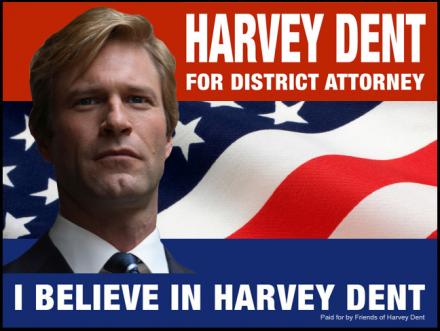
ABOVE: Aaron Eckhart's on the edge DA Harvey Dent is as important to the film as Batman or The Joker.
I saw this on the IMAX, since six of the action sequences were filmed especially for IMAX viewing. It was beautifully filmed and a feast for the eyes to behold. You do not have to see it on the IMAX, it would look great on a regular screen too, but I was certainly glad I was in an IMAX theater when Batman was soaring over the skyline of Hong Kong (wow). Poetry on celluloid (although, they don't really use celluloid anymore, do they?)

ABOVE: The Joker offers Assistant DA Rachel Dawes some free facial surgery
All of this is prelude to Heath Ledger's turn as The Joker. I don't need to remind most of you that this was Ledger's final full performance. The prodigiously talented young actor died in January from an overdose of prescription drugs. So much has been said of his performance (demands for an oscar nomination, and so forth). I honestly wanted to dislike it, just a little, because the praises that have been heaped on this performance for months have become a little tiresome. Again, believe the hype. With all due respect to Cesar Romero and Jack Nicholson, Ledger brings this iconic villain into brand new territory. It is a testament to his talent and emersion into the role that you walk into the theater thinking about Heath Ledger, but within five minutes it is simply The Joker that true Batman fans have always wanted on the screen. Ledger's Joker is no mere dangerous clown, he is a nihilistic sadist who believes only in pure anarchy. His motives are not money or power. He is driven by chaos. It is a great scene when the wise Alfred tells a puzzled Batman, who is still looking for traditional motivations in his new nemesis, that "some men just want to watch the world burn." Ledger's Joker is one of the greatest villains I have ever seen on the big screen.
I have read most of the important Batman graphic novels since the 1990's, and this Joker is the Joker of 'The Killing Joke' (Director Nolan supposedly gave Ledger the graphic novel for research. Ledger evidently studied it well.) Ledger's Joker gleefully uses death and mayhem for sociological experimentation. He has no real past (a funny recurring "joke" is his always changing story about how he got his hideous carved smile on his face, which is wonderfully reminiscent of Conrad Veidt in 1928's 'The Man Who Laughs'. Joker creates his own back story to suit the occasion, and seems to believe it every time he tells it.) It is a tribute to this whip smart script that the well worn psychological aspects of Batman vs. Joker (the good and bad sides of the same freakish coin) comes across as fresh and thought provoking. When The Joker chillingly tells Batman "you complete me," enough has transpired in the film to where it is a sincere and wonderfully twisted moment.
The film is relentlessly dark, although there are some funny Joker quips here or there, and a great Joker cross dressing scene. If there is any complaint I have at all is that at two and a half hours, it may run a tad long. But that is a small complaint when you are watching such compelling escapism, and honestly, I enjoyed every second of it.
**** out of *****
Friday, July 18, 2008
Dez's Favorite Rock/Pop Records, #'s 70-66
Perhaps it is because I fancy myself a musician, but I generally focus on the music over the lyrics in rock songs. Let’s face it, as a general proposition, notwithstanding Bob Dylan, you are not going to find brilliant lyric writing in rock and roll. But even when you do have amazing lyrics, if the tune does not catch my attention, then I am generally not that interested (see Leonard Cohen). On the other hand, a great melody or rock and roll energy can mask the most asinine lyrics (see Dave Matthews and Kiss). Excuse the length of the entries this time around, but several of these demanded extended discussion.
70. Randy Newman – Land of Dreams, 1988
Often overlooked in his catalogue, this little gem will really get under your skin if you give it the chance. Newman puts aside his trademark quirky compositional style, and delivers a set of fairly straightforward rock songs. Part of the credit goes to co-producer and guest guitarist Mark Knopfler (best showcased on the cynical single, “It’s Money That Matters,” one of those classic Newman tunes where you are not really sure on which side of the issue he really stands). Check out the autobiographical opening trilogy of “Dixie Flyer,” “New Orleans Wins the War” and “Four Eyes”. “Dixie Flyer” is a lovely song, detailing a young boy’s arrival to the Big Easy over a smooth rolling piano line which invokes the lazy currents of the Mississippi River flowing by the French Quarter. “New Orleans Wins the War” wonderfully captures the spirit and culture unique to New Orleans, including the residents’ obliviousness to outside concerns or dangers (sometimes to their detriment, as Hurricane Katrina demonstrated). It is full of vivid detail about life and attitudes in New Orleans:
“Don’t remember much about my baby days, but I been told
We used to live on Willow in the Garden District, next to the Sugar Bowl
Momma used to wheel me past an ice cream wagon
One side for White, one side for Colored
I remember trash cans floatin’ down Canal Street, it rained every day one summer
Momma used to take me to Audubon Park, show me the ways of the world
She said, ‘here comes a white boy, there goes a black one, that one’s an octoroon
This little cookie here’s a macaroon, that big thing’s a red balloon
And the paper down here’s called the Picayune
And here’s a New Orleans tune’…
Daddy said, ‘I’m gonna get this boy out of this place
Bound to sap his strength
People have fun here, and I think that they should
But nobody from here ever come to no good
They’re gonna pickle him in brandy, and tell him he’s saved
Then throw fireworks all ‘round his grave’
So he took us down to the airport, and flew us back to L.A.
That was the end of my baby days…”
Newman shows a wide range of emotion here, “Something Special” is a heartfelt love song, while the devastating “I Want You To Hurt Like I Do” is cynical and cruel Rand at his best, sung over a lovely and peaceful melody.

ABOVE: Randy Newman’s Land of Dreams is his most autobiographical record
69. David Bowie – Low, 1977
It may be hard to understand in this day and age just what a risk #69 was at the time. But make no mistake, without Low there would be no OK Computer from Radiohead or Achtung Baby from U2. For #69, Bowie teamed up with uber-producer Brian Eno, and they hunkered down and recorded this icy masterpiece. Half of it is made of jagged, intense song fragments, while the other half is cold, ambient instrumentals. It is a fascinating move for such a mainstream artist like Bowie to make. Not surprisingly, it was greeted with suspicion and confusion on release, but in hindsight many critics declare #69 a landmark release. It undoubtedly influenced many future forays by rock artists into the avant-garde fringe. Eno is as crucial to this record as Bowie, they would team up for two more records (thereby creating what is commonly called The Berlin Trilogy), but none were as arresting or shocking as this one.
68. The Allman Brothers Band – Eat a Peach, 1972
What should have been an unfocused mess from a band still reeling from the tragic death of their guiding light Duane Allman (one of the greatest guitar talents ever to grace the instrument)…The Brothers turn in one of their greatest triumphs. From the ashes of Duane’s fatal motorcycle crash they assembled the sprawling double record Eat a Peach. It is a hodgepodge of tracks; some they had recorded with Duane before his death, some were additional live tracks from the same Fillmore shows that made up their landmark live record, and then some new tracks were recorded post-Duane. The pleasant surprise here is that the new stuff not only boldly leads the record off, but is probably the best material. “Ain’t Wastin’ Time No More” opens with their most soulful groove yet and Gregg Allman’s signature piece “Melissa” remains the prettiest song in their entire catalogue. As far as the live material goes, “One Way Out” and “Trouble No More” are as strong as anything that was originally included on Live at the Fillmore East, and while the 34-minute “Mountain Jam” may be a bit hard to sit through unless you are devoted, it is worth it, as it shows just how great that entire band, and especially Duane, were in the live improvisational setting. The song is a monstrous and intricate half hour jam based on the three minute Donovan pop confection “There Is a Mountain”, showing that they could take any source material and explore it as deftly as Miles Davis or John Coltrane often did with the pop songs of their day. “Blue Sky” shows Dickey Betts taking more of a welcome lead with his country-influenced material. The record appropriately closes with a lovely acoustic duet between Duane and Dickey, “Little Martha”, one of the few Duane Allman-composed songs to appear on record.

ABOVE: Eat a Peach is truly victory clutched from the jaws of defeat
67. Led Zeppelin – untitled (aka 'IV', aka 'Four Symbols', aka 'Zoso', aka Kick Ass), 1971
Do I even need to go into this one? For classic rock fans the world over, this is THE record. “Black Dog” is the definition of epic guitar riffs from Jimmy Page and rock god wailing from Robert Plant, “Misty Mountain Hop” has a monstrous groove while being a humorous hippie satire, “Rock and Roll” takes a simple 1950’s rock and roll rhythm and supercharges it for the cock rock 70’s, while “The Battle of Evermore” and “Going To California” are acoustic gems. My favorite is the closer, the menacing “When the Levee Breaks”, which is one of the scariest blues songs ever recorded by a rock band. Zeppelin made their name initially as a supercharged blues-rock band, but for the first time, they move beyond mere rocking blues imitations and create something new from the form. Finally, Zeppelin makes blues its own, bringing it to their terms. John Bonham’s titanic drum beat could shift continents. It is an utterly haunting song and has never been equaled, and takes on even more power when considered with the events of Katrina in New Orleans. (Fun fact: Bonham’s drum beat in “When the Levee Breaks” is one of the most sampled beats in rap music). Am I forgetting anything? Oh, yeah, a little ditty called “Stairway to Heaven” is tucked away at the end of side 1.
66. Jeff Beck – Blow By Blow, 1975
After going through a revolving door of lead singers of various quality to sing for his Jeff Beck Group (a young Rod Stewart being the most notable), Beck finally decided to forget the distracting vocals altogether and record his first instrumental record. After #66, most of his releases would be instrumental, with an occasional guest vocalist on a tune or two. Having become bored with being a hard rock guitarist, he took a bold left turn and decided to record a jazz/rock fusion record. #66 is one of the most successful and most important releases in all of instrumental rock or fusion. With crucial help (most notably from producer George Martin, keyboard wiz and composer Max Middleton and loose drumming from Richard Bailey), Beck hits this one out of the park. “Freeway Jam” has rightfully become one of Beck’s signature tunes, but “AIR Blower”, the furious and adventurous “Scatterbrain”, the funky “Thelonious” and the gorgeous Stevie Wonder-penned “’Cause We’ve Ended As Lovers” are just as great. #66 is especially satisfying because Beck has top notch collaborators with him, and he gives a clinic in both lead and rhythm guitar playing. A note of caution: you will have to adjust to the admittedly dated 70’s fusion sound here, but once you get past that and just listen to the playing, it is astoundingly great. Also, while none appear on this list, his most recent three releases, a trilogy of sorts (Who Else!, You Had It Coming and Jeff) are three of his most adventurous and balls-to-the-wall albums of his entire career. While contemporaries either age into AOR snoozeville or pointlessly ape the old blues masters (I’m talking to you, Clapton) or live off past glories (Jimmy Page), Jeff Beck continues to evolve and get more daring the older he gets.
70. Randy Newman – Land of Dreams, 1988
Often overlooked in his catalogue, this little gem will really get under your skin if you give it the chance. Newman puts aside his trademark quirky compositional style, and delivers a set of fairly straightforward rock songs. Part of the credit goes to co-producer and guest guitarist Mark Knopfler (best showcased on the cynical single, “It’s Money That Matters,” one of those classic Newman tunes where you are not really sure on which side of the issue he really stands). Check out the autobiographical opening trilogy of “Dixie Flyer,” “New Orleans Wins the War” and “Four Eyes”. “Dixie Flyer” is a lovely song, detailing a young boy’s arrival to the Big Easy over a smooth rolling piano line which invokes the lazy currents of the Mississippi River flowing by the French Quarter. “New Orleans Wins the War” wonderfully captures the spirit and culture unique to New Orleans, including the residents’ obliviousness to outside concerns or dangers (sometimes to their detriment, as Hurricane Katrina demonstrated). It is full of vivid detail about life and attitudes in New Orleans:
“Don’t remember much about my baby days, but I been told
We used to live on Willow in the Garden District, next to the Sugar Bowl
Momma used to wheel me past an ice cream wagon
One side for White, one side for Colored
I remember trash cans floatin’ down Canal Street, it rained every day one summer
Momma used to take me to Audubon Park, show me the ways of the world
She said, ‘here comes a white boy, there goes a black one, that one’s an octoroon
This little cookie here’s a macaroon, that big thing’s a red balloon
And the paper down here’s called the Picayune
And here’s a New Orleans tune’…
Daddy said, ‘I’m gonna get this boy out of this place
Bound to sap his strength
People have fun here, and I think that they should
But nobody from here ever come to no good
They’re gonna pickle him in brandy, and tell him he’s saved
Then throw fireworks all ‘round his grave’
So he took us down to the airport, and flew us back to L.A.
That was the end of my baby days…”
Newman shows a wide range of emotion here, “Something Special” is a heartfelt love song, while the devastating “I Want You To Hurt Like I Do” is cynical and cruel Rand at his best, sung over a lovely and peaceful melody.

ABOVE: Randy Newman’s Land of Dreams is his most autobiographical record
69. David Bowie – Low, 1977
It may be hard to understand in this day and age just what a risk #69 was at the time. But make no mistake, without Low there would be no OK Computer from Radiohead or Achtung Baby from U2. For #69, Bowie teamed up with uber-producer Brian Eno, and they hunkered down and recorded this icy masterpiece. Half of it is made of jagged, intense song fragments, while the other half is cold, ambient instrumentals. It is a fascinating move for such a mainstream artist like Bowie to make. Not surprisingly, it was greeted with suspicion and confusion on release, but in hindsight many critics declare #69 a landmark release. It undoubtedly influenced many future forays by rock artists into the avant-garde fringe. Eno is as crucial to this record as Bowie, they would team up for two more records (thereby creating what is commonly called The Berlin Trilogy), but none were as arresting or shocking as this one.
68. The Allman Brothers Band – Eat a Peach, 1972
What should have been an unfocused mess from a band still reeling from the tragic death of their guiding light Duane Allman (one of the greatest guitar talents ever to grace the instrument)…The Brothers turn in one of their greatest triumphs. From the ashes of Duane’s fatal motorcycle crash they assembled the sprawling double record Eat a Peach. It is a hodgepodge of tracks; some they had recorded with Duane before his death, some were additional live tracks from the same Fillmore shows that made up their landmark live record, and then some new tracks were recorded post-Duane. The pleasant surprise here is that the new stuff not only boldly leads the record off, but is probably the best material. “Ain’t Wastin’ Time No More” opens with their most soulful groove yet and Gregg Allman’s signature piece “Melissa” remains the prettiest song in their entire catalogue. As far as the live material goes, “One Way Out” and “Trouble No More” are as strong as anything that was originally included on Live at the Fillmore East, and while the 34-minute “Mountain Jam” may be a bit hard to sit through unless you are devoted, it is worth it, as it shows just how great that entire band, and especially Duane, were in the live improvisational setting. The song is a monstrous and intricate half hour jam based on the three minute Donovan pop confection “There Is a Mountain”, showing that they could take any source material and explore it as deftly as Miles Davis or John Coltrane often did with the pop songs of their day. “Blue Sky” shows Dickey Betts taking more of a welcome lead with his country-influenced material. The record appropriately closes with a lovely acoustic duet between Duane and Dickey, “Little Martha”, one of the few Duane Allman-composed songs to appear on record.

ABOVE: Eat a Peach is truly victory clutched from the jaws of defeat
67. Led Zeppelin – untitled (aka 'IV', aka 'Four Symbols', aka 'Zoso', aka Kick Ass), 1971
Do I even need to go into this one? For classic rock fans the world over, this is THE record. “Black Dog” is the definition of epic guitar riffs from Jimmy Page and rock god wailing from Robert Plant, “Misty Mountain Hop” has a monstrous groove while being a humorous hippie satire, “Rock and Roll” takes a simple 1950’s rock and roll rhythm and supercharges it for the cock rock 70’s, while “The Battle of Evermore” and “Going To California” are acoustic gems. My favorite is the closer, the menacing “When the Levee Breaks”, which is one of the scariest blues songs ever recorded by a rock band. Zeppelin made their name initially as a supercharged blues-rock band, but for the first time, they move beyond mere rocking blues imitations and create something new from the form. Finally, Zeppelin makes blues its own, bringing it to their terms. John Bonham’s titanic drum beat could shift continents. It is an utterly haunting song and has never been equaled, and takes on even more power when considered with the events of Katrina in New Orleans. (Fun fact: Bonham’s drum beat in “When the Levee Breaks” is one of the most sampled beats in rap music). Am I forgetting anything? Oh, yeah, a little ditty called “Stairway to Heaven” is tucked away at the end of side 1.
66. Jeff Beck – Blow By Blow, 1975
After going through a revolving door of lead singers of various quality to sing for his Jeff Beck Group (a young Rod Stewart being the most notable), Beck finally decided to forget the distracting vocals altogether and record his first instrumental record. After #66, most of his releases would be instrumental, with an occasional guest vocalist on a tune or two. Having become bored with being a hard rock guitarist, he took a bold left turn and decided to record a jazz/rock fusion record. #66 is one of the most successful and most important releases in all of instrumental rock or fusion. With crucial help (most notably from producer George Martin, keyboard wiz and composer Max Middleton and loose drumming from Richard Bailey), Beck hits this one out of the park. “Freeway Jam” has rightfully become one of Beck’s signature tunes, but “AIR Blower”, the furious and adventurous “Scatterbrain”, the funky “Thelonious” and the gorgeous Stevie Wonder-penned “’Cause We’ve Ended As Lovers” are just as great. #66 is especially satisfying because Beck has top notch collaborators with him, and he gives a clinic in both lead and rhythm guitar playing. A note of caution: you will have to adjust to the admittedly dated 70’s fusion sound here, but once you get past that and just listen to the playing, it is astoundingly great. Also, while none appear on this list, his most recent three releases, a trilogy of sorts (Who Else!, You Had It Coming and Jeff) are three of his most adventurous and balls-to-the-wall albums of his entire career. While contemporaries either age into AOR snoozeville or pointlessly ape the old blues masters (I’m talking to you, Clapton) or live off past glories (Jimmy Page), Jeff Beck continues to evolve and get more daring the older he gets.
Wednesday, July 16, 2008
The Worst Actor on Television?
I should have posted this weeks ago. Thanks to Hoodlumman for providing this link. He provided the link in the lively discussion for my post, What Are You Watching? Subsequently, I have watched this about five times and showed it to friends and family. It is a compilation of the "best" of Horatio Cain's (played by the one and only David Caruso) dramatic one-liners right before the opening credits roll on "CSI: Miami". As it unfurls before you, it just builds and builds in absurdity. No, it is not a Saturday Night Live skit (it is funnier than anything on SNL for about a decade). This is the real thing. Be sure to stick with it to the end, because the final scenes are the best. Amazingly, he delivers about 80% of his dialogue throughout each episode in the same dramatic, stilted manner. And it doesn't matter how important the dialogue is in any particular scene. ("Frank...excuse me [puts on shades]...I need to go...to the restroom"). I know this because I have watched way more "CSI: Miami" than I ever wanted to. My usually sane wife absolutely loves this show.
So, my question to you is this: is there a worse actor on television than David "Shades" Caruso? Before you answer that question, watch this clip compilation in its entirety.
So, my question to you is this: is there a worse actor on television than David "Shades" Caruso? Before you answer that question, watch this clip compilation in its entirety.
Tuesday, July 15, 2008
William Claxton photos
One of my favorite photographers is William Claxton. Claxton is best known for his striking (mostly) black and white photos of jazz figures (some famous, some not) and other selected celebs and artists. I figured I'd share some of my favorites...
We'll start with my very favorite of Claxton's. Below is the Stan Kenton Band on some beach. Lots of things I love about the photo. Use of shadows is brilliant. There is an exuberance about the band, and if you are familiar with Kenton's music, you know that his was one of the most bombastic of the big bands. It just captures a mood rare in photographs.

Claxton had a special relationship with Steve McQueen. I'd say at least a fourth of his famous photos are of McQueen, and Claxton has an entire book out featuring just shots of him. McQueen was famously jealous of Claxton photographing anyone else. Steve once told Claxton that he could not photograph McQueen if he took shots of anyone else remotely famous, and McQueen even tailed Claxton and his wife on one of their evenings out to spy on Claxton to make sure he wasn't meeting with other celebs. There are lots of McQueen photos to choose from, but I like this...

And this...

Other great celeb shots include Natalie Wood...

Lenny Bruce...

Frank Sinatra...

And he has a host of great jazz photos. Some are as follows.
Miles Davis (capturing his confrontational attitude perfectly)...

Duke Ellington...

Thelonious Monk...

Chet Baker...

Charlie Parker...

Cootie Williams...

There are many, many more that I love. I've got a fantastic coffee table book called "Jazz" with lots of his great jazz photos. If you want to see more, go here.
We'll start with my very favorite of Claxton's. Below is the Stan Kenton Band on some beach. Lots of things I love about the photo. Use of shadows is brilliant. There is an exuberance about the band, and if you are familiar with Kenton's music, you know that his was one of the most bombastic of the big bands. It just captures a mood rare in photographs.

Claxton had a special relationship with Steve McQueen. I'd say at least a fourth of his famous photos are of McQueen, and Claxton has an entire book out featuring just shots of him. McQueen was famously jealous of Claxton photographing anyone else. Steve once told Claxton that he could not photograph McQueen if he took shots of anyone else remotely famous, and McQueen even tailed Claxton and his wife on one of their evenings out to spy on Claxton to make sure he wasn't meeting with other celebs. There are lots of McQueen photos to choose from, but I like this...

And this...

Other great celeb shots include Natalie Wood...

Lenny Bruce...

Frank Sinatra...

And he has a host of great jazz photos. Some are as follows.
Miles Davis (capturing his confrontational attitude perfectly)...

Duke Ellington...

Thelonious Monk...

Chet Baker...

Charlie Parker...

Cootie Williams...

There are many, many more that I love. I've got a fantastic coffee table book called "Jazz" with lots of his great jazz photos. If you want to see more, go here.
Friday, July 11, 2008
Dez's Favorite Rock/Pop Records, #'s 75-71
Don’t take this list as a definitive list of my favorite bands or artists. Sure, most of my favorites will probably make the list. But there are some individual records listed that belong to bands I’m not really crazy about, overall. They just captured lightning in a bottle once or twice. Conversely, I’ve got some favorite artists who only appear once or not at all. Remember the list is about putting together great records from start to finish. No matter how great some individual songs, if other songs are filler, then it likely will not be here. Even Van Morrison’s best albums have filler, and his worst albums have some moments of sublime brilliance. That’s just the way Van the Man rolls. But make no mistake, the fact that Van Morrison will only appear once on my list takes nothing from the fact that he remains one of my favorite artists. Ditto several others.
75. Van Morrison – Astral Weeks, 1968
One of the most gorgeous but impenetrable records in rock, it is hardly a rock record at all. Van was disappointed with the pop direction of his solo debut, and due to disagreements with his original label, he went underground for awhile. Putting together small acoustic combos, he developed his dramatic new material in small clubs along the East Coast. When he finally entered the studio again, he was a very different artist from the one who had recorded the popular but inconsequential “Brown Eyed Girl” (a song he famously despises). Featuring Van on acoustic guitar surrounded by an acoustic jazz bass, flutes and Modern Jazz Quartet drummer Connie Kay, the pastoral music of #75 envelops lyrics verging on stream of consciousness genius. There are no familiar hits here, it is all of a piece. Tunes like the title track and fan favorite “Cyprus Avenue” are delicate, extended masterpieces. One of my favorite songs of all time is the closer “Slim Slow Slider”. There is a certain moment in that song, when Van sings “you’re out of reach” and later when he sings “I know you’re dyin’, baby”, and the bass hits that note in the minor chord…wow. Goosebumps every time. This record took me years of repeated attempts to finally “get,” but it is worth the effort. Few artists go this deep within themselves, much less record it and then release it.

ABOVE: As one critic famously said about Van Morrison’s Astral Weeks: “I have no idea what Van Morrison is singing about, but I know it is beautiful.”
74. The Beatles – The Beatles (aka ‘The White Album’), 1968
A sprawling mess, The White Album is a band on the brink of self-destruction. The Fab Four were basically four solo artists at this point, with each member acting as a guest musician on the other’s songs. Harrison’s gem is “While My Guitar Gently Weeps”, with an uncredited Eric Clapton playing the solo. Given so much sonic space, Lennon and McCartney deliver a dizzying set of styles and sounds, from beautiful acoustic to electronic whimsy. Books have been written about The White Album, but I like to focus on the fact that the most celebrated rock songwriting duo defy their own stereotypes here. McCartney delivers the hardest rocking song in the entire Beatles repertoire, “Helter Skelter”; while Lennon gives us a spare, gorgeous and melodic ballad in “Julia”. McCartney shows witty wordplay with “Rocky Raccoon”; while Lennon delivers a killer multi-part suite with “Happiness Is a Warm Gun”. And "Why Don't We Do It In the Road?" is about as Lennon-like as you can get, yet that was all Paul. (In fact, years later, Lennon expressed disappointment that Paul did not include him on that track, as it was recorded only by Paul and Ringo. Paul fired back that Lennon did "Revolution 9" alone, "John is now the nice guy, and I'm the bastard.") All bets are off on The White Album, it is The Beatles at their most raw as they pulled back from the studio trickery (for the most part) and let the music flow regardless of the consequences. Most double albums should have been tighter single records, but the sprawl and lack of cohesion was kind of the point here, so the double album format just makes #74 all the more powerful.

ABOVE: The cover art for the White Album is simple, beautiful, classic. No, this is not the test pressing. It's like a white mirror, you can see yourself in both sides. There's something about this that is so white, the question is how much more white could it be? The answer is none. None more white.
73. Shawn Colvin – Steady On, 1989
Colvin’s debut is a lovely and often haunting modern folk/rock record. She writes engaging tunes, plays great acoustic guitar, and has a beautiful voice; so all of the elements are there. Producer and guitarist John Leventhal had a lot to do with the ethereal vibe of many of these songs. Highlights include “Shotgun Down the Avalanche”, “Diamond in the Rough” and “Ricochet in Time”. She went in a more mainstream adult contemporary direction on subsequent releases to much commercial success, but none of her later work has the emotional immediacy of #73. Fat City was a decent follow-up, though.
72. Zwan – Mary Star of the Sea, 2003
I’ve always viewed #72 as the best Smashing Pumpkins album. The Pumpkins were always basically Billy Corgan anyway, and this short-lived Corgan side project featured two out of four Pumpkins. Whatever name you want to assign to it, this record is Corgan at his balls out rocking and melodic songwriting best. Tune after tune has punch and killer hooks. The sad thing about Corgan is that he is making music in the wrong era. His style of huge bombastic rock would have been right at home in the 70’s. If you liked Smashing Pumpkins’ Siamese Dream, then you will love this. Unfortunately Zwan only lasted this one record; they soon broke up acrimoniously, and to this day Corgan refuses to even listen to the Zwan material. Too bad, because it is some of his very best.
71. Steve Winwood – Back in the High Life, 1986
Whenever I put these lists together, I usually catch some flak for including this one. Winwood was one of the most prodigiously talented artists in the rock era, and he doesn’t get the credit he deserves. Part of it is his own doing, after the 70’s his work was spotty and disappointing overall. But he got it right on #71. Generally AOR-type stuff rightfully gets dismissed by true rock fans, but every once in awhile someone comes along with such deft craft and melodic touch, that they can defy the restrictions of the genre. #71 is one of the best pure pop records of the 80’s, with Winwood dressing himself up as a purveyor of blue eyed pop and soul, using horns, pleasing synths, and overlapping percussion to create a thick musical stew. The strengths, not surprisingly, lie in the four diverse and outstanding hit singles: the joyous “Higher Love”, the contemplative title track (with great backing vocals from James Taylor), the beautiful synth ballad “The Finer Things”, and the groovy rocker “Freedom Overspill” (featuring some fantastic slide guitar from Joe Walsh). Winwood hit a long slump after #71, but his most recent albums About Time and Nine Lives are both promising returns to form (his 70’s form, not 80’s).
75. Van Morrison – Astral Weeks, 1968
One of the most gorgeous but impenetrable records in rock, it is hardly a rock record at all. Van was disappointed with the pop direction of his solo debut, and due to disagreements with his original label, he went underground for awhile. Putting together small acoustic combos, he developed his dramatic new material in small clubs along the East Coast. When he finally entered the studio again, he was a very different artist from the one who had recorded the popular but inconsequential “Brown Eyed Girl” (a song he famously despises). Featuring Van on acoustic guitar surrounded by an acoustic jazz bass, flutes and Modern Jazz Quartet drummer Connie Kay, the pastoral music of #75 envelops lyrics verging on stream of consciousness genius. There are no familiar hits here, it is all of a piece. Tunes like the title track and fan favorite “Cyprus Avenue” are delicate, extended masterpieces. One of my favorite songs of all time is the closer “Slim Slow Slider”. There is a certain moment in that song, when Van sings “you’re out of reach” and later when he sings “I know you’re dyin’, baby”, and the bass hits that note in the minor chord…wow. Goosebumps every time. This record took me years of repeated attempts to finally “get,” but it is worth the effort. Few artists go this deep within themselves, much less record it and then release it.

ABOVE: As one critic famously said about Van Morrison’s Astral Weeks: “I have no idea what Van Morrison is singing about, but I know it is beautiful.”
74. The Beatles – The Beatles (aka ‘The White Album’), 1968
A sprawling mess, The White Album is a band on the brink of self-destruction. The Fab Four were basically four solo artists at this point, with each member acting as a guest musician on the other’s songs. Harrison’s gem is “While My Guitar Gently Weeps”, with an uncredited Eric Clapton playing the solo. Given so much sonic space, Lennon and McCartney deliver a dizzying set of styles and sounds, from beautiful acoustic to electronic whimsy. Books have been written about The White Album, but I like to focus on the fact that the most celebrated rock songwriting duo defy their own stereotypes here. McCartney delivers the hardest rocking song in the entire Beatles repertoire, “Helter Skelter”; while Lennon gives us a spare, gorgeous and melodic ballad in “Julia”. McCartney shows witty wordplay with “Rocky Raccoon”; while Lennon delivers a killer multi-part suite with “Happiness Is a Warm Gun”. And "Why Don't We Do It In the Road?" is about as Lennon-like as you can get, yet that was all Paul. (In fact, years later, Lennon expressed disappointment that Paul did not include him on that track, as it was recorded only by Paul and Ringo. Paul fired back that Lennon did "Revolution 9" alone, "John is now the nice guy, and I'm the bastard.") All bets are off on The White Album, it is The Beatles at their most raw as they pulled back from the studio trickery (for the most part) and let the music flow regardless of the consequences. Most double albums should have been tighter single records, but the sprawl and lack of cohesion was kind of the point here, so the double album format just makes #74 all the more powerful.

ABOVE: The cover art for the White Album is simple, beautiful, classic. No, this is not the test pressing. It's like a white mirror, you can see yourself in both sides. There's something about this that is so white, the question is how much more white could it be? The answer is none. None more white.
73. Shawn Colvin – Steady On, 1989
Colvin’s debut is a lovely and often haunting modern folk/rock record. She writes engaging tunes, plays great acoustic guitar, and has a beautiful voice; so all of the elements are there. Producer and guitarist John Leventhal had a lot to do with the ethereal vibe of many of these songs. Highlights include “Shotgun Down the Avalanche”, “Diamond in the Rough” and “Ricochet in Time”. She went in a more mainstream adult contemporary direction on subsequent releases to much commercial success, but none of her later work has the emotional immediacy of #73. Fat City was a decent follow-up, though.
72. Zwan – Mary Star of the Sea, 2003
I’ve always viewed #72 as the best Smashing Pumpkins album. The Pumpkins were always basically Billy Corgan anyway, and this short-lived Corgan side project featured two out of four Pumpkins. Whatever name you want to assign to it, this record is Corgan at his balls out rocking and melodic songwriting best. Tune after tune has punch and killer hooks. The sad thing about Corgan is that he is making music in the wrong era. His style of huge bombastic rock would have been right at home in the 70’s. If you liked Smashing Pumpkins’ Siamese Dream, then you will love this. Unfortunately Zwan only lasted this one record; they soon broke up acrimoniously, and to this day Corgan refuses to even listen to the Zwan material. Too bad, because it is some of his very best.
71. Steve Winwood – Back in the High Life, 1986
Whenever I put these lists together, I usually catch some flak for including this one. Winwood was one of the most prodigiously talented artists in the rock era, and he doesn’t get the credit he deserves. Part of it is his own doing, after the 70’s his work was spotty and disappointing overall. But he got it right on #71. Generally AOR-type stuff rightfully gets dismissed by true rock fans, but every once in awhile someone comes along with such deft craft and melodic touch, that they can defy the restrictions of the genre. #71 is one of the best pure pop records of the 80’s, with Winwood dressing himself up as a purveyor of blue eyed pop and soul, using horns, pleasing synths, and overlapping percussion to create a thick musical stew. The strengths, not surprisingly, lie in the four diverse and outstanding hit singles: the joyous “Higher Love”, the contemplative title track (with great backing vocals from James Taylor), the beautiful synth ballad “The Finer Things”, and the groovy rocker “Freedom Overspill” (featuring some fantastic slide guitar from Joe Walsh). Winwood hit a long slump after #71, but his most recent albums About Time and Nine Lives are both promising returns to form (his 70’s form, not 80’s).
Subscribe to:
Posts (Atom)
