Thursday, July 10, 2008

'Band of Brothers' (book and mini-series)


I’ve been a fan of the HBO mini-series for years, but I just finished reading the book by Stephen Ambrose on which the series was based. The book has more detail, naturally, but the series is quite true to Ambrose’s narrative. So they can be reviewed together.

‘Band of Brothers’ follows one company of soldiers through World War II. This was no ordinary company. This was “Easy” Company. That is, E Company, 406th Regiment, 101st Airborne. Serving in Easy was anything but easy. With over a 100% casualty rate, your chances of coming home unscathed were pretty low. (100% casualty doesn’t mean that every person in the company was killed or wounded. If the company has approximately 150 men at full strength, it means that over the course of the war more than 150 men were killed or wounded. As men got wounded, got promoted, earned transfers or somehow got to go home, reinforcements came in to replace them. Say 350 or so men went through Easy’s ranks throughout the war, but over 150 of those men were either killed or wounded...that’s how the math works.) Easy was a paratrooper company, but they only made a couple of jumps during the War. Most of their time was spent as an elite ground infantry unit that was repeatedly sent on the most dangerous missions. Over a period of a little over one year, Easy landed behind enemy lines on D-Day, fought in Holland in a very dangerous operation that eventually failed, held out through the hell of Bastogne in the Battle of the Bulge, and eventually was on the front lines for the invasion of Germany. They were also one of the first companies to arrive at Berchtesgaden and Hitler’s mountain getaway ("The Eagle's Nest"), getting first crack at Hermann Goering’s incomparable wine collection.

The depictions of battle in both the book and the series are superlative and harrowing. They stand up there with the “best” of 'Saving Private Ryan' or 'Schindler’s List' in war realism. A particularly striking scene in both formats is when Easy are approaching the drop zone in Normandy on D-Day (actually, they were dropped the night before). Easy was one of several elite paratrooper companies dropped behind German lines as the D-Day assault occurred on the beaches. Their mission was to knock out as many of the German batteries as possible in order to make the beach landings easier. What this meant was mounting raids on German encampments and engaging in fierce fire fights and often brutal hand to hand combat with battle-hardened German soldiers. This was their first taste of real battle after months and months of intense training. The shock and intensity of German anti-aircraft guns blazing at the bombers carrying the paratroopers to their drop zones is one of the more memorable experiences I have had watching anything on television. It tells you how intense it was when the paratroopers were scrambling to jump out of the planes before they reached their destination, thereby landing somewhere unknown behind enemy lines in the middle of the night, just to get away from the bombardment. If you are a war buff (like me), then you will be happy to know that scenes like this are plentiful throughout 'Band of Brothers.'

But one of the most intriguing aspects of Easy to me was how two very different men shaped the character of the company. One was Capt. Herbert Sobel, and the other was Maj. (although he was a Lieutenant when he led Easy) Dick Winters. Sobel was in many respects a disaster of a leader. He was a tyrant in boot camp, capricious and sadistic (but then some argue that is exactly what a drill sargeant in training camp is supposed to be). In the field he was incompetent, unable to read a map and constantly making basic tactical mistakes. The men of Easy were so afraid of taking orders from Sobel in real combat that all of the junior non-commissioned officers in the company risked court martial by resigning their positions en masse. The higher-ups clearly saw the writing on the wall and thankfully transferred Sobel before Normandy (to train more hapless recruits). David Schwimmer does a fantastic job in the series of playing Sobel in all of his petty glory.

Winters took over Easy after Sobel’s replacement was killed on D-Day, and he was the ultimate leader in every way. He had a gift for tactics and for improvising on the ground, and he also had a deep understanding and connection with his men. The survivors of Easy, decades later, still spoke of Winters as if he were a semi-deity. In fact, one of Winters' attacks on a German stronghold of machine gun nests was so artful, it is still studied at West Point to this day. It is clear why Winters had such an impact, but what I found fascinating was that many Easy survivors, although to a man they all despised Sobel, also credited Sobel for making them who they were. Ambrose refers to Sobel as “a petty tyrant” more than once in his book, and he chronicles Sobel’s abuses through page after entertaining page. But Ambrose also wrote: “I asked every member of Easy that I interviewed for this book if the extraordinary closeness, the outstanding unit cohesion, the remarkable staying power of the identification with Easy came because of or in spite of Sobel. Those who did not reply ‘Both,’ said it was because of Sobel. [One veteran] looked me in the eye and said flatly, ‘Herbert Sobel made E Company.’ Others said something similar. But they nearly all hated him.” Sobel, through his sadistic ways, trained and pushed Easy harder than any other unit in the U.S. Army were trained. He just would have been a horrible combat commander. ( A favorite scene: Sobel decides to give the men a break from training and orders a nice spaghetti dinner to be cooked. Right at the end of the dinner after the men have gourged themselves, Sobel bursts in and orders a 10 mile run up a mountain. You can imagine the result.)
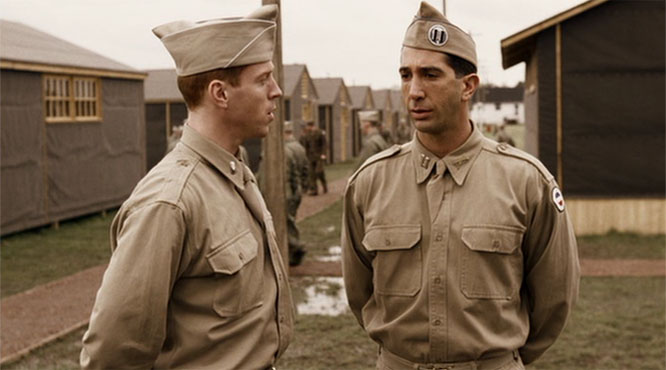

ABOVE: The two men who made Easy Company what it was, Winters (played by Damian Lewis) and Sobel (David Schwimmer)

It is true that Ambrose views the men of Easy as heroes. If there is a flaw at all, it may be that Ambrose worships these men a bit too much. But he also points out the mistakes that were made as well, he does not paint a perfect picture. But let’s face it, this was a group of extraordinary men. I was also struck with how Ambrose eloquently describes the close bonds that are formed in battle. He says: “They found in combat the closest brotherhood they ever knew. They found selflessness. They found they could love the other guy in their foxhole more than themselves. They found that in war, men who loved life would give their lives for them.”

It is a remarkable book and a remarkable mini-series. I would recommend checking out both. But if you've only got time or interest for one or the other, check out the mini-series first. It is wonderful and engrossing filmmaking.

Finally, I’ll let the legendary Maj. Winters have the last word:

“That extra special, elite, close feeling started under the stress Capt. Sobel created at Camp Toccoa. Under that stress, the only way the men could survive was to bond together. Eventually the non-coms had to bond together in a mutiny. The stress in training was followed by the stress in Normandy of drawing the key combat mission for gaining control of Utah Beach. In combat your reward for a good job done is that you get the next tough mission. E Company kept right on getting the job done through Holland – Bastogne – Germany. The result of sharing all that stress throughout training and combat has created a bond between the men of E Company that will last forever.”

**** out of ***** (for both book and mini-series)

Tuesday, July 8, 2008

Keep Your Day Job, Dude


Vanderbilt’s Shan (pronounced “Shane”) Foster was recently drafted by the Dallas Mavericks. In celebration, he wrote and performed this tune. Funny enough, it kinda stays in your head after you hear it. Several of the sports talk radio guys have been playing the tune and making fun of the guy incessantly. But it's a bit touching, actually, that he is so excited and enthusiastic about his future. Of course, you know that the first opponent who slams on Foster is gonna sing “I can’t wait / to play in the NBA…” right in his grill.

Monday, July 7, 2008

Flip Floppin' Through the Summer

The predictable cries of “flip-flop” were heard last week when Obama backtracked from his (absurd) primary promises to withdraw U.S. forces from Iraq on his pre-determined timeline, whatever the consequences. He used these earlier promises to draw a contrast between himself and Hillary, who did not have the luxury of claiming to have always opposed the war in Iraq. Now Obama is having to deal with the publicity fallout of his “refinement” of his timetable for troop withdrawal, convening hastily planned follow-up press conferences and then blaming the media for not understanding his nuanced positions in the first place regarding “the mission”, “tactical decisions” and so forth. In one sense it is nice to see Obama squirm a little bit, since he has generally been confronted with nothing short of a fawning press corps up to now (the Rev. Wright couple of weeks notwithstanding).

I get increasingly frustrated with the “flip-flop” charge in political campaigns. On the one side, perhaps it indicates indecisiveness and lack of knowledge or experience. That is certainly what McCain’s people will claim (and should claim, strategically speaking). On the other hand, the shrill cries of “flip-flopper” seem to deny that a candidate can develop his own views over time and rightfully change his mind as circumstances demand. Put it in the context of the business world. What would a corporate Board do to an executive who stuck to certain policies and principles no matter how the markets shifted or developed? They’d fire his ass for being inflexible and not being cognizant enough of his ever changing environment. Now, I know that this comparison is not completely valid. You do need a set of core values and principles to define yourself when dealing with domestic policy and with other nations. But with Obama here, this does not seem to be a case of changing core values. This is a case of him finally speaking to military commanders and getting the scoop on the entire situation.

McCain is right in the sense that Obama should have been seeking these military perspectives a hell of a lot earlier than now. McCain has visited Iraq multiple times to see for himself. Obama should have been doing the same. McCain can rightly counter that this has been the situation all along (at least through the primary season up to now), so a wiser statesman would have realized it sooner than last week.


ABOVE: Perhaps Obama finally understands the situation in Iraq

I will tell you this. I have been looking for excuses to support Obama. I really like him and respect him, and in many ways I feel that his election would be a positive seismic event for our country. But one of the main things that hold me back is his (now previous?) position on Iraq.

McCain’s folks will hurl accusations of “flip-flopper” at him (and I don’t blame them, they have to) and liberal bloggers and other leftists will wring their hands and cry in their lattes that he may not be the Great Left Hope that they had imagined. BUT, for that huge and crucial number of voters who hover around the great Middle (either slightly left of it or slightly right)…Obama’s “refinements” might just win him the election. Before last week there was no way I would vote for Obama. After last week, there is now a small chance that I will. I have always supported and respected John McCain, but his time was 2000. He got screwed by the Rove machine in South Carolina. And honestly I think McCain can be more effective as the “maverick” Senator than as President. No knock on McCain, he is one of the most significant American politicians of the last decade.

But I am ready for some Obama magic. The deal breaker for me is if he screws up our crucial successes in Iraq because of some asinine pre-determined withdrawal date. I’ll say it again: your views on whether Bush should have gone in to Iraq in the first place are largely irrelevant as to what should be done now. Perhaps Obama himself now sees the stupidity of his primary-era statements after finally speaking to the commanders and men and women on the ground. I believe that I have stated this before, but I’ve got a couple of good friends who have served over there. One friend, who has served two tours and will probably go back for a third, insists that our progress in Iraq is real and positive. He says that amongst the people who are on the ground, the consensus is overwhelmingly in favor of finishing the job. He says within the last year there has been an incredible change in the population’s attitudes and feelings about the future. There is an optimism in Iraq that was not present a year ago, and many of the citizens acknowledge that the U.S. forces are largely responsible. John McCain has understood that all along. Maybe Obama is starting to understand that as well. Keep “refining”, Barry. I’ll be watching intently.

Thursday, July 3, 2008

Happy 4th of July

Happy birthday USA, courtesy of Jimi Hendrix. I love the interview intro with Little Richard ("hair-o-run"), and stay tuned to the end of the clip for a great interview with Hendrix about the aftermath of this performance.

Wednesday, July 2, 2008

Dez's Favorite 100 Rock/Pop Records, #'s 80-76

GNABB Programming Note: Since this Friday falls on the 4th, I figured nobody would be checking their computers. So, You get this week's installment a little early. We will return to Fridays next week. Tomorrow you'll get a 4th of July treat.

What about those records that defy easy genre categorization? Is Stevie Ray Vaughan blues? Rock? Blues/rock? It is a judgment call, but I generally decide by the dominant style displayed on the record. Stevie Ray Vaughan’s records are really blues albums with rock and roll elements or a couple of rock songs thrown in…but they are blues records. So, SRV’s Couldn’t Stand the Weather doesn’t qualify for the list, although it is a favorite record of mine. Ditto for Gram Parsons and the Flying Burrito Brothers on Gilded Palace of Sin. Sure it has some rock elements and influenced lots of rock artists, but it is really a country record.

80. Steely Dan – Can’t Buy a Thrill, 1972
I know Dan fans prefer the records that came after their debut, but this is the one I go back to the most. The wry, sophisticated lyrics and gleaming studio perfection were in place from the beginning. #80 features three of their catchiest hits: the groovy samba “Do It Again”, “Dirty Work” and “Reeling in the Years”, which features some of the tastiest guitar licks of the 70’s courtesy of session great “Skunk” Baxter. Steely Dan were ostensibly a band, but they were always really just Donald Fagen and Walter Brecker and their army of ace L.A. session musicians. While many rock fans criticize the use of studio guns for hire (it somehow lacks DIY rock credibility, and I must admit, more often than not, it creates rather soulless product), Fagen/Brecker made an art out of hand picking the penultimate professionals for their Steely Dan albums and really got the best out of these studio mercenaries. Dan's jazz leanings would become more pronounced on subsequent releases, but it is still detectable here.

79. Yes – The Yes Album, 1971
It wasn’t until their third record that Yes found their sound. I know most fans would pick the next two releases as quintessential Yes (and it is hard to argue against Fragile or Close to the Edge), but I’ve always enjoyed this one from their classic period. They move into the full complexity of their prog rock glory, but are still somewhat rooted in rock and roll vs. getting into the overblown concept pieces of later years. Part of that is due to the presence of Tony Kaye on organ instead of the more celebrated and self-indulgent Rick Wakeman (who would join the line-up on the next release). Yes staples “Yours Is No Disgrace”, “Starship Trooper” and “I’ve Seen All Good People” are all here. The complexity of those first two songs is matched by a thrilling drive, surprises, shifting tempos and changing moods at every turn. I am always a bit surprised at how little recognition Chris Squire gets as a bassist and Steve Howe gets as a guitarist. Both prove to be masters of their instruments here.

78. Santana – Santana III, 1971
This is the greatest line-up of the revolving door band that is centered around the guitar playing prowess of Carlos Santana. Keyboard wizard and vocalist Gregg Rollie is still on board, but what makes this such a great record is the addition of second guitarist Neal Schon (both Rollie and Schon would soon leave Santana to form Journey). In Schon, Carlos found a worthy guitar foil, and these two titans of the axe spar and trade licks on a record that is a guitar player’s nirvana. Over half of the record is comprised of latin-propulsed instrumental jams that boil over into six string maelstroms. “Batuka”, “Toussaint L’Overture”, “Guajira”, “Jungle Strut” and “Para Los Rumberos” all burn. “No One To Depend On” is a favorite groovy hit, “Taboo” is an eerie change of mood, “Everybody’s Everything” was a surprise pop hit, and Carlos himself even takes a rare lead vocal on the catchy “Everything’s Coming Our Way”. Abraxas may get the vote from most critics, but for my money, Santana III is the peak from Santana’s most accomplished era.

77. Prince – Purple Rain, 1984
The Purple One’s pop/rock masterpiece was a seminal record of the 1980’s. #77 has tantalizing tastes of rock, R&B, dance, funk, avant-garde…but most importantly, it is flawless pop music of the highest order. It is rare these days to find a black artist who views himself primarily as a rock and roll performer, but that is what Prince was on this album. He decides to add “guitar hero” to his list of accomplishments on his ever expanding resume. People don’t often realize what a great guitarist he is. Good arguments include the killer break in “Let’s Go Crazy” or the majestic solo in the title track. “When Doves Cry” is a remarkable hit single, as it does not have a bass line in it at all! Very innovative and daring, and one critic called it the most avant-garde hit single in pop history (it reached #1). When I was a kid, I thought “Darling Nikki” was the dirtiest song in the world.


ABOVE: The peak of Prince's output

76. Rod Stewart – It Had To Be You: The Great American Songbook…JUST KIDDING, actually…

76. Rod Stewart – Every Picture Tells a Story, 1971

There once was a time, a long time ago in a galaxy far away, when Rod Stewart was not a cheesy pop star or schmaltzy lazy interpreter of standards. There was a time when Rod Stewart was a gritty, hard living, rocker. This is the Rod that I try and remember. Rod’s partnership with guitarist Ron Wood produced a series of outstanding records in the early 70’s (both with the Faces and under the ‘Rod Stewart’ banner), and this one was the peak of that collaboration. The title track is a thrilling tale of jet setting and fast living, while the tender “Mandolin Rain” and “Reason To Believe” are perfect contrast. The big hit was “Maggie May” (perhaps his most famous song). He even throws in down and dirty covers of the Temptations classic “I’m Losing You” and Elvis’ “That’s Alright”. The sound of this record (and his others recorded around this time) is a perfect hybrid, they rock hard but the instrumentation is largely acoustic. #76 is one of the best and most seamless blends of rock, soul and folk I’ve come across. If you are not familiar with this Rod Stewart of yore, check it out and you will be pleasantly surprised. And then saddened at how his career subsequently developed after such promise (starting out as lead singer of the groundbreaking but short-lived Jeff Beck Group, then with the awesome Faces and his first exciting years as a solo artist…he could have been one of the greats if he had stayed on track). Stewart’s Achilles Heel has been that he is not much of a songwriter, and so he often depends on others to supply the material (although, he wrote or co-wrote the three best songs on #76).

Tuesday, July 1, 2008

Toby Update


As you can see above, Toby seems to be doing much better. If you have no idea what I am talking about, check out the original Toby post here. He's not out of the woods yet, and still has some additional tests coming up to determine where he stands, but his most recent tests indicate improvement and all outward indications are that he is recovering from his many life-threatening ailments nicely. Plus, ANCIANT just put up more cute puppy pictures at his blog here, so I had to retaliate with my own arsenal of canine cuteness. Here's another volley, ANCIANT...

Dez Reviews: 'Easy Riders, Raging Bulls' (book) by Peter Biskind


I recently finished reading ‘Easy Riders, Raging Bulls’ by Peter Biskind, and would highly recommend it for anyone interested in moviemaking. It is a rather salacious account of Hollywood in the late 60’s and 70’s, the time of the “New Hollywood.” For many film buffs, this was a golden age of personal and daring filmmaking. The book chronicles the rises and falls, the sex, violence, excesses and genius of such figures as Francis Coppola, Martin Scorsese, Dennis Hopper, William Friedkin, Steven Spielberg, George Lucas, Robert Evans, Robert Altman, Jack Nicholson, Peter Bogdonovich and a host of other movers and shakers in 70’s Hollywood. Not only does it tell many juicy tales, such as Dennis Hopper threatening the lives of virtually everyone involved in the making of Easy Rider, but the book also offers an in depth analysis of the effect of these films on popular culture and on Hollywood, as well as of what went right and what went horribly wrong in this period.

I was particularly interested in this theme that Biskind follows throughout, how the old Hollywood studio system was dying, so these young guns came along and started this revolution from within that thrived for about eight years, and then it was undermined from within by the likes of Lucas and Spielberg, who (perhaps unwittingly) re-established the power of the studio system. Naturally a book that celebrates the personal filmmaking of Scorsese and Hal Ashby would not look kindly on blockbusters like Jaws or Star Wars. According to Biskind, the runaway success of those two films conspired with other factors and excesses to put an end to the exciting 70’s era of filmmaking.

Biskind declares: “When all was said and done, Lucas and Spielberg returned the ‘70s audience, grown sophisticated on a diet of European and New Hollywood films, to the simplicities of the pre-60’s Golden Age of movies…They were, as [Pauline] Kael first pointed out, infantilizing the audience, reconstituting the spectator as child, then overwhelming him and her with sound and spectacle, obliterating irony, aesthetic self-consciousness, and critical reflection…We are the children of Lucas, not Coppola.”

Lucas himself has a cynical view of it all. Biskind quotes Lucas as saying “Star Wars didn’t kill the film industry…Popcorn pictures have always ruled. Why do these people go see these popcorn pictures when they’re no good? Why is the public so stupid? That’s not my fault. I just understood what people liked to go see, and Steven [Spielberg] has too, and we go for that.” Lucas then rather defensively (and unconvincingly) argues that Star Wars brought in so much money, that it caused the increase in multiplexes and screens, and those screens had to be filled with something; therefore the money from the Star Wars-type films helped to subsidize the smaller, more personal films that now had room to thrive in the multiplexes. Martin Scorsese fires back “They’re not subsidizing everything else…Star Wars was in. Spielberg was in. We were finished.” William Friedkin (director of The Exorcist and The French Connection) complains that “Star Wars was like when McDonald’s got a foothold, the taste for good food just disappeared. Now we’re in a period of devolution.” And Robert Altman stated a few years back that going to the movie theater these days is “one big amusement park ride. It’s the death of film.” Both sides make valid arguments. I mean, it is undeniable that Jaws and Star Wars are both great entertainment. In a certain sense, can you really get angry at filmmakers for doing nothing other than making great entertainment that the masses enjoy?

There is more than a little bit of jealousy in some of these statements; as the Biskind book makes clear, these directors all knew each other, hung out, and were fiercely competitive. They wanted to make “films” (as opposed to mere movies), yet they also wanted financial success and acclaim. In fact, Lucas first tried to make art films that were decidedly noncommercial. He was so embittered by how he was treated by the studios, that he made American Graffiti and Star Wars almost in retaliation, in part to prove to the studios that he could make a commercial movie if he felt like it. Lucas scoffs at how easy it is to make a commercial film, saying “emotionally involving the audience is easy: anybody can do it blindfolded. Get a little kitten and have some guy wring its neck.”


ABOVE: George Lucas (the one on the left), killer of both (symbolic) kittens and (actual) good filmmaking, oversees his Star Wars empire

The above back and forth is from about three pages in the 439 page book, so as you can imagine, it is full of fascinating discussions and arguments about the push and pull between art and commerce. And Dennis Hopper threatening to kill people. A good read.

**** out of *****